Materia Medica · Dravyaguna
Bibhitaki
Terminalia bellirica · Combretaceae
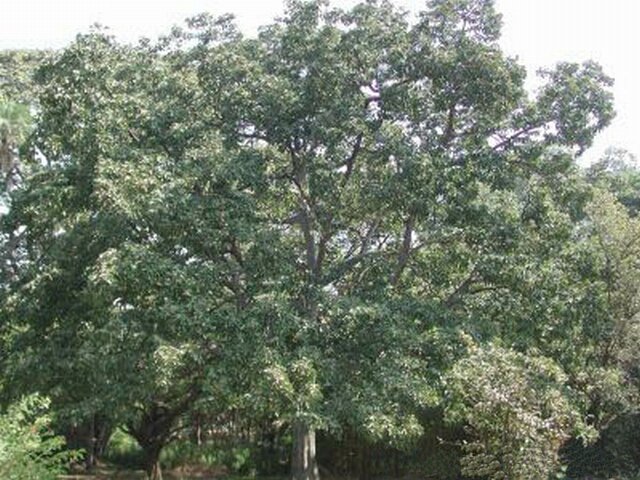

Bibhitaki is the fruit of a tall forest tree and one of the three that go into Triphala. On its own, the tradition reaches for it mostly to clear the heavy, damp quality it calls Kapha.
- Botanical name
- Terminalia bellirica
- Family
- Combretaceae
- Sanskrit
- बिभीतक
- Part used
- The fruit, with the stone removed
- Taste (rasa)
- Astringent (kashaya)
- Quality (guna)
- Light and dry (laghu, ruksha)
- Energy (virya)
- Warming (ushna)
- After digestion (vipaka)
- Sweet (madhura)
- Action (karma)
- Settles Kapha, supports the voice and the hair (kaphahara)
- Best known for
- One of the three fruits of Triphala
What is Bibhitaki?
Bibhitaki is the fruit of a large forest tree, Terminalia bellirica, that grows across the Indian subcontinent and south-east Asia. The tree is tall, sometimes thirty metres, with the leaves bunched at the ends of the branches. The fruit is small, oval and grey, with a fine velvety skin and a single hard stone inside. It is the flesh of the fruit, with the stone taken out, that Ayurveda uses.
Most people meet Bibhitaki without knowing it, because it is one of the three fruits in Triphala, the famous Ayurvedic blend. The other two are Amalaki and Haritaki. The name is usually read as coming from a word for fearless, and the classical writers liked to say the fruit gave a certain steadiness to the one who used it.
What Ayurveda uses it for
Within Triphala, each of the three fruits is matched to one of the three doshas, and Bibhitaki is the one matched to Kapha, the heavy, cool, damp quality of the body. So on its own, the tradition reaches for it most when there is too much of that heaviness: a damp, sluggish feeling, a wet cough, congestion of the chest. The texts place it in their groups of herbs for the cough and for clearing.
Bibhitaki also carries a long reputation for the hair and the voice. Its powder turns up in classical hair preparations, and the tradition links it with the throat and a clear voice. Like the other two myrobalans, it is also valued for the eyes, and the three together are the basis of the classical eye wash.
Its qualities, in plain words
Ayurveda describes each herb by a short list of qualities, and Bibhitaki has a tidy one.
Its taste is astringent, the drawing, drying taste you feel from strong tea, which the tradition links with clearing damp and firming the tissues. It is light and dry in quality and warming in effect, and all of that points the same way: towards settling the heavy, wet Kapha. But there is a twist at the end. After digestion its effect turns sweet, and a sweet finish in Ayurveda means a herb that, for all its drying surface, still feeds the body rather than wearing it down. That balance is why it sits so well in a daily blend.
How it is taken
The classic way is as a powder. The dried fruit, with the stone removed, is ground fine and taken in small amounts, often stirred into warm water. By far the most common way to take it, though, is as one third of Triphala, the equal blend of the three fruits, which is among the most widely used preparations in all of Ayurveda.
For the hair, a decoction of the fruit is sometimes used as a rinse. Internal use, whether alone or in a blend, is classically done as a course over time, and the amount is best judged with a practitioner.
Good to know
Bibhitaki is rarely thought of by itself in everyday Ayurveda; its real home is Triphala, where it works alongside Amalaki and Haritaki. The three are chosen so that between them they meet all three doshas, which is why the blend is treated as so gentle and so suitable for regular use. Only the flesh of the fruit is used; the hard inner stone is always discarded.
This entry describes the classical Ayurvedic understanding of the herb. It is not medical advice, and anyone with a health condition should speak to a qualified practitioner.
Frequently asked
What is Bibhitaki best known for? Being one of the three fruits of Triphala. On its own, the tradition reaches for it mostly to settle the heavy, damp quality it calls Kapha.
Is it the same as the other myrobalans? No. Bibhitaki, Amalaki and Haritaki are three different fruits from three different trees. They are grouped together in Triphala because each one suits a different dosha.
Which part is used? The flesh of the fruit, with the single hard stone removed and thrown away. The stone is not part of its preparations.
Bibhitaki is astringent and warming, and it settles the cough and the heaviness of Kapha.
After the Bhavaprakasha Nighantu, on the three myrobalans
Frequently asked questions
What is Bibhitaki used for?
Bibhitaki, the large forest fruit Terminalia bellirica, is one of the three fruits of Triphala. Ayurveda uses it mainly to settle the heavy, damp Kapha quality, classing its action as kaphahara, and the texts also link it with supporting the voice and the hair. Astringent in taste, it is a classical Kapha-clearing myrobalan, usually taken within formulas.
Is Bibhitaki one of the three fruits of Triphala?
Yes. Triphala, meaning three fruits, is made of Bibhitaki, amla, or Amalaki, and Haritaki. Bibhitaki, Terminalia bellirica, is the Kapha-clearing member of the trio, contributing its astringent rasa and kaphahara action. Together the three fruits balance all three Doshas, which is why Triphala is one of the most used formulas in Ayurveda.
What are the benefits of Bibhitaki for Kapha?
Ayurveda classes Bibhitaki as kaphahara, meaning it settles the heavy, damp, cool Kapha quality, which is its main traditional use. Its astringent rasa dries and lightens, and the texts also connect the fruit with the voice and the hair. It is usually taken within Triphala or other formulas rather than alone, and is best used with guidance.
How do you take Bibhitaki?
Bibhitaki is most often taken as a powder from the dried fruit, either on its own in warm water or, more commonly, as part of Triphala. The dose depends on the purpose and the person. Because it is a reducing, Kapha-clearing fruit, its amount and course are best set by a qualified Ayurvedic practitioner rather than self-chosen.
What is the difference between Bibhitaki and Haritaki?
Both are myrobalan fruits in Triphala, but they act differently. Bibhitaki, Terminalia bellirica, is chiefly kaphahara, drying and clearing the damp Kapha quality. Haritaki, Terminalia chebula, is broader and more Vata-directed, valued for gentle regulation of the gut. Amla completes the trio for Pitta. A practitioner chooses between them by the Dosha needing attention.
References
- Charaka Samhita, Sutrasthana, on the Jvarahara and Kasahara groups of herbs.
- Bhavaprakasha Nighantu, Haritakyadi Varga, on the three fruits of Triphala.
- Ashtanga Hridayam, on the use of the myrobalans in Triphala.