Materia Medica · Dravyaguna
Bilva
Aegle marmelos · Rutaceae
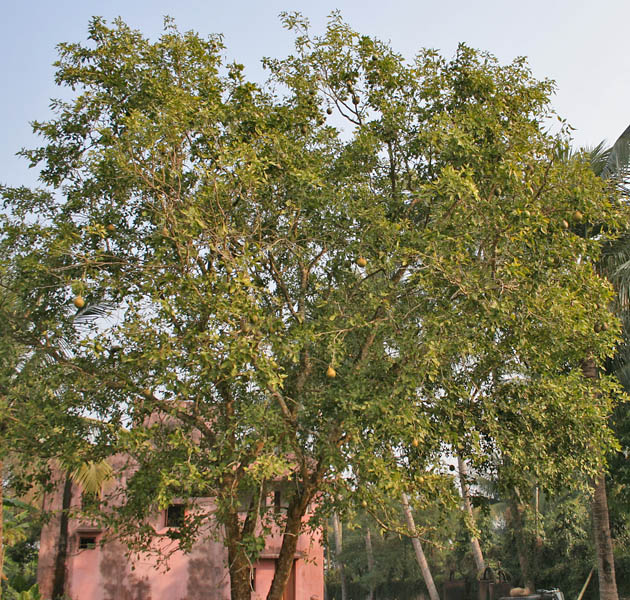
_tree_at_Narendrapur_W_IMG_4116.jpg)
Bilva is the fruit of a thorny tree held sacred to Shiva, whose trifoliate leaf is offered at his temples. Ayurveda reaches for the unripe fruit as one of its classic binding, absorbent substances for a loose and unsettled digestion, and counts the root among the five great roots.
- Botanical name
- Aegle marmelos
- Family
- Rutaceae
- Sanskrit
- बिल्व
- Part used
- Unripe fruit (root used in Dashamula preparations)
- Taste (rasa)
- Astringent and bitter (kashaya, tikta)
- Quality (guna)
- Light and dry (laghu, ruksha)
- Energy (virya)
- Warming (ushna)
- After digestion (vipaka)
- Pungent (katu)
- Action (karma)
- Binds and absorbs, kindles digestion (grahi, deepana)
- Effect on dosha
- Settles Kapha and Vata (kapha-vata-hara)
- Best known for
- An unripe fruit that binds and steadies the digestion
What is Bilva?
Bilva is the fruit of a thorny, slow-growing tree, Aegle marmelos, of the citrus family, native to India and long planted near homes and temples across the subcontinent. The tree is unmistakable once you know it: crooked branches set with sharp spines, and a leaf divided into three leaflets on a single stalk. That trifoliate leaf is sacred to Shiva and is offered at his shrines, which is one reason the tree has been protected and cultivated for so many centuries.
The names carry both the sacred and the plain sense of the plant. Shriphala, one of its Sanskrit names, means “the fruit of Shri,” the auspicious fruit, a reflection of its place in worship. In everyday use it is called Bael or Bel, and in English wood apple, after its hard, woody rind. The fruit is round and heavy, green when young and turning yellow as it ripens. Here lies a point that matters for the whole entry: Ayurveda treats the unripe fruit and the ripe fruit as almost two different medicines. It is chiefly the young, unripe fruit, the bilva phala, that the classical texts reach for.
What Ayurveda uses it for
Bilva is best known for one clear action. The unripe fruit is a classic grahi substance, a word that describes something binding and absorbent, which draws things together and firms up what has grown loose and watery in the digestive tract. At the same time it is deepana, meaning it kindles the digestive fire. Astringent, warming and light, the young fruit was understood to steady an unsettled gut while it gently rekindled a weak digestion, which is why the tradition returns to it again and again for the loose and flowing complaints of the belly.
The root of the tree has a separate and equally settled place. It is one of the Brihat Panchamula, the five great roots, and through them one of the ten roots of Dashamula, the famous group used to settle aggravated Vata. In that role the part used is the root, not the fruit, and the action is quite different from the fruit’s binding work.
Within its main role the dravyaguna texts describe Bilva as traditionally indicated in a familiar set of conditions, each named here in its classical Sanskrit term with a plain gloss:
- Atisara: loose and frequent motion, the fruit’s classical home as a binding remedy.
- Grahani: the classical disorder of disturbed digestion and absorption, where its double binding and fire-kindling action was valued.
- Pravahika: motion with straining and discomfort, the condition later texts call dysenteric.
- Agnimandya: a weak or sluggish digestive fire, which its warming, kindling quality was said to rouse.
- Arsha: the classical category of haemorrhoids, where the drying, astringent fruit was applied.
- Shotha: swelling, addressed chiefly through the root within the great-root group.
- Krimi: the classical category of intestinal worms, for which the fruit is mentioned.
These are the traditional textual indications recorded in the classical literature. They set out how Ayurveda has long understood the herb and are given for reference and study, not as statements of medical effect or as advice to treat any condition.
Its qualities, in plain words
Ayurveda describes every herb by a short list of qualities, and for Bilva they line up plainly behind its reputation as a binder.
Its taste is astringent, with a bitter note, and in Ayurveda astringency is the taste that draws in, dries and firms up. It is light and dry, so rather than feeding and grounding the body it lightens and reduces, which is exactly what the tradition wants when things have turned loose and watery. It is warming, and this is what lets it kindle a sluggish digestive fire rather than dampen it further. And it finishes pungent after digestion, in keeping with its warming, stimulating character. Put these together and you have a light, dry, warm and astringent fruit, which is why the tradition settles so firmly on its binding, fire-kindling action and places it against the cold, heavy, watery quality of Kapha and the mobile quality of Vata. Because its dryness could unsettle a body already dry, that warming and drying nature is best matched to the damp and sluggish rather than the parched.
How it is taken
The classical form is a preparation of the unripe fruit, most often dried and made into a powder or a paste. A well-known simple preparation is Bilva pesika, the dried slices of the young fruit, from which decoctions and powders are drawn. The vehicle is chosen to match the aim: the fruit is often given with warm water, or with simple accompaniments such as honey or buttermilk that the tradition pairs with binding, digestion-firming remedies.
Bilva also lends its name and its substance to several named preparations. It is the central herb of the Bilvadi group of formulas built around the fruit. As a root it enters the Brihat Panchamula and so the wider Dashamula preparations, among them Dashamularishta, a fermented tonic, and Dashamula Kwatha, a classical decoction, where it works alongside the other great roots rather than on its own. In these root preparations the fruit’s binding quality is not the point; it is the root’s Vata-settling action that is being drawn upon.
Good to know
The single most important thing to hold about Bilva is the difference between the unripe and the ripe fruit. The tradition treats the young, unripe fruit as the binding, absorbent, digestion-firming remedy described throughout this entry. The ripe fruit is understood quite differently and is not interchangeable with it, so the classical texts are careful to specify the unripe fruit for the binding action. Bilva is also a herb of the drying, reducing side of Ayurveda rather than the nourishing side, which is why the tradition matches it to loose, damp and sluggish states and is cautious where the body is already dry. And it is worth remembering that the fruit and the root are, in effect, two different remedies: the fruit for the digestion, the root for the great-root preparations that settle Vata.
This entry describes the classical Ayurvedic understanding of the herb. It is not medical advice, and anyone with a health condition should speak to a qualified practitioner.
Frequently asked
Why does Ayurveda use the unripe fruit rather than the ripe one? Because the two are understood as almost different medicines. The young, unripe fruit is the astringent, binding and absorbent remedy the classical texts call for in loose and unsettled digestion. The ripe fruit is regarded quite differently and is not used in its place, which is why the tradition takes care to name the unripe fruit for this action.
Is Bilva a fruit remedy or a root remedy? Both, in two separate roles. The unripe fruit is the famous binding, digestion-firming substance. The root is one of the five great roots, the Brihat Panchamula, and enters the ten-root Dashamula preparations that settle Vata. The part used depends entirely on the preparation.
Why is the tree considered sacred? Its trifoliate leaf, three leaflets on one stalk, is offered to Shiva and used in his worship, and the tree carries the name Shriphala, “the auspicious fruit.” For this reason the Bilva has been protected, planted near temples and cultivated across India for a very long time.
The unripe Bilva is astringent, warming and light; it kindles the digestive fire, absorbs and binds, and is praised in disorders of loose motion and disturbed digestion.
After the Bhavaprakasha Nighantu, on Bilva
Bilva root stands among the great roots; taken together they settle the aggravated Vata and are the foundation of the ten-root decoction.
After the Sushruta Samhita, on the Panchamula groups
Frequently asked questions
What is Bilva used for in Ayurveda?
Bilva, Aegle marmelos, is valued for its unripe fruit, which Ayurveda classes as grahi and deepana: binding, absorbent and digestion-kindling. It is a classic remedy for loose, unsettled digestion. Its root also serves among the Dashamula, the great ten roots. The tradition prizes the unripe fruit especially for steadying and binding the belly.
Is Bilva good for diarrhoea and digestion?
In the classical tradition the unripe Bilva fruit is a foremost grahi, binding, remedy, traditionally used for loose stools, Atisara, and a weak, unsteady digestion. It absorbs and firms while kindling Agni. The ripe fruit, by contrast, is regarded differently. For persistent digestive upset, use it under a qualified practitioner and consult your doctor.
What is the difference between ripe and unripe Bilva fruit?
Ayurveda draws a clear line: the unripe or half-ripe Bilva fruit is grahi and deepana, prized for binding and steadying the digestion, while the fully ripe fruit is considered heavier and less suited to the same use, and can be harder on digestion. The tradition therefore favours the unripe fruit for digestive complaints.
Which dosha does Bilva balance?
Bilva settles Kapha and Vata, described as kapha-vata-hara. Its astringent and bitter rasa, with warming, absorbent qualities, dries damp Kapha and steadies Vata in the gut. This is why the unripe fruit suits cold, loose, Vata and Kapha digestive states. Being drying and warming, it is used more carefully in high Pitta.
How do you take Bilva for the stomach?
The unripe fruit is classically dried and made into Bilva churna or a decoction, and it features in formulations such as Bilvadi. It may be taken with a suitable anupana for the digestion. Because dose depends on the complaint and constitution, guidance from a qualified Ayurvedic practitioner is advised, especially for lasting digestive trouble.
References
- Charaka Samhita, Sutrasthana, chapter 25, where the unripe Bilva is named among the finest remedies for the binding, absorbent action (grahi).
- Sushruta Samhita, Sutrasthana, on the Brihat Panchamula, the five great roots, of which Bilva root is one.
- Bhavaprakasha Nighantu, Guduchyadi Varga, entry on Bilva with its synonyms, qualities and uses.
- Ashtanga Hridaya, Chikitsasthana, on the treatment of Atisara and Grahani, where the unripe fruit is repeatedly called for.
- Raja Nighantu, listing the many Sanskrit synonyms of the tree, including Shriphala and Shailusha.