Materia Medica · Dravyaguna
Nyagrodha
Ficus benghalensis · Moraceae
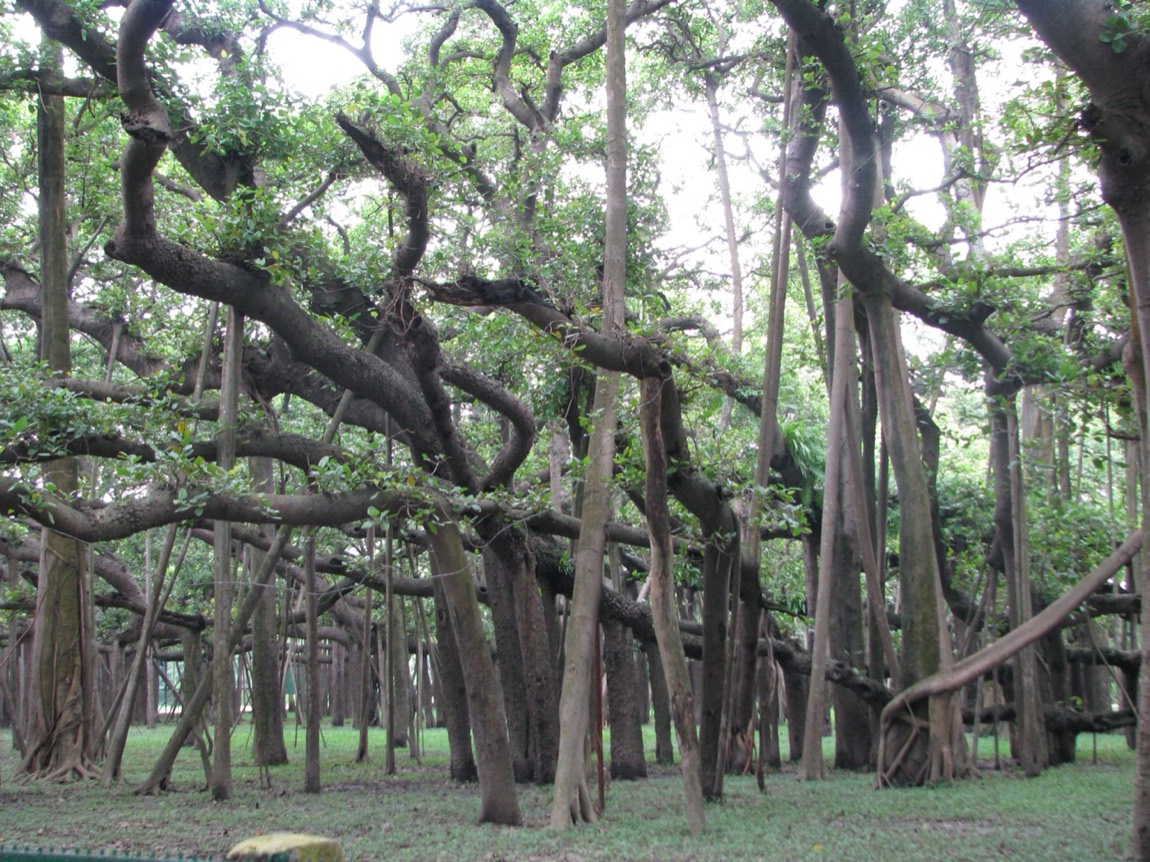

Nyagrodha is the great spreading banyan tree, whose bark Ayurveda groups among the cooling, astringent barks. It is one of the five barks of the classical Panchavalkala group, long used in washes and pastes for the care of external tissue.
- Botanical name
- Ficus benghalensis
- Family
- Moraceae
- Sanskrit
- न्यग्रोध
- Part used
- Bark (twak) chiefly; also prop root, tender leaf and the milky latex
- Taste (rasa)
- astringent, with a secondary sweet (kashaya, madhura)
- Quality (guna)
- heavy and dry (guru, ruksha)
- Energy (virya)
- Cooling (sheeta)
- After digestion (vipaka)
- pungent (katu)
- Action (karma)
- holding and consolidating, soothing to swelling (grahi, stambhana, sophahara)
- Best known for
- a cooling, astringent bark from the banyan tree
What is Nyagrodha?
Nyagrodha is the banyan tree, one of the most recognisable trees of the Indian subcontinent. Botanically it is Ficus benghalensis, a member of the fig family, Moraceae. The tree is famous for the aerial roots that hang down from its branches and, on reaching the ground, thicken into new trunk-like pillars called prop roots. Over time a single tree can spread outward across a wide area and appear almost like a small grove.
The Sanskrit name Nyagrodha carries the sense of “growing downward”, a direct nod to those descending roots. In classical texts and in everyday Indian languages the tree is just as often called Vata, and in Hindi it is known as Bargad or Bad. Several of its other names, such as Bahupada (many-footed) and Shringi, again describe its many rooting limbs.
In Ayurveda the part most used is the bark, called twak. The aerial or prop root, the tender leaf and the milky latex, known as ksheera, are also described. It is the bark, though, that gives Nyagrodha its place among the classical astringent, cooling substances.
What Ayurveda uses it for
Classical Ayurveda places Nyagrodha firmly among the cooling, astringent barks. In the Sushruta Samhita it actually gives its name to a whole group of drugs, the Nyagrodhadi gana, a set of astringent and cooling substances that Nyagrodha heads. The Charaka Samhita lists it among the Kashaya Skandha, the class of astringent-tasting drugs, and also within the Mutrasangrahaniya group.
The traditional role recorded for the bark is that of a holding, consolidating substance. The classical action terms used are grahi and stambhana, both of which describe the quality of drawing together and holding rather than dispersing. Alongside these, texts note varnya, relating to the healthy appearance and complexion of the skin, vranaropana, supporting the natural healing of external tissue, and sophahara, a soothing quality with respect to swelling.
Perhaps its best known classical use is as one of the five barks of the Panchavalkala group. This group brings together Nyagrodha with Udumbara, Ashwattha, Plaksha and Parisha, and it is used traditionally in washes and pastes for the care of external tissue. In this sense Nyagrodha rarely stands alone. It works as part of a small, time-honoured family of barks that share its cooling and astringent character.
Its qualities, in plain words
Ayurveda describes every substance through a short set of qualities, and Nyagrodha’s tell a consistent story.
Its rasa, or taste, is chiefly kashaya, astringent. That is the dry, slightly puckering quality you notice in strong tea or unripe fruit. Some of the classical plant glossaries, the nighantus, add a secondary madhura, or sweet, note as well. Its guna, the physical qualities, are guru and ruksha, meaning heavy and dry.
Its virya, the potency or the warming or cooling effect a substance has on the body, is sheeta, cooling. Its vipaka, the taste that remains after digestion is complete, is katu, pungent.
Put together in plain words, Nyagrodha reads as a cool, dry, astringent bark. The astringent taste and the cooling potency are the qualities Ayurveda leans on when it groups the herb with substances that gather and settle rather than spread and heat. Because these qualities pull in a calming, consolidating direction, the tradition describes Nyagrodha as Kapha-Pitta shamaka, that is, pacifying to both Kapha and Pitta.
How it is taken
In the classical tradition Nyagrodha is prepared in a few straightforward ways. The bark is dried and ground into a powder, called churna. It is boiled in water to make a decoction, known as kashaya or kwatha. It is made into a paste for external application, and the milky latex of the tree is used in its own right.
Its most familiar formulation is the Panchavalkala group itself, the classical combination of five barks in which Nyagrodha sits alongside Udumbara, Ashwattha, Plaksha and Parisha. Preparations built on these five barks are among the most enduring in the Ayurvedic care of external tissue, and Nyagrodha’s astringent, cooling bark is a core member of that set. The tree also gives its name to the Nyagrodhadi gana of the Sushruta Samhita, the group of astringent drugs it heads.
This entry does not give prescriptive amounts. Classical dosage depends on the person, the preparation and the guidance of a qualified practitioner, and the safest course is always to follow that guidance rather than a fixed figure.
Good to know
Nyagrodha is a substance of the cooling, astringent kind, and in the classical tradition such herbs are usually chosen with care for the season and the individual constitution rather than taken casually. Because its qualities are drying and consolidating, they are best matched to a person and a context by someone who understands the wider picture, which is exactly the role of the Ayurvedic practitioner.
This entry describes the classical Ayurvedic understanding of the herb. It is not medical advice, and anyone with a health condition, and anyone who is pregnant or breastfeeding, should speak to a qualified practitioner before use.
Frequently asked
Is Nyagrodha the same as the banyan tree? Yes. Nyagrodha is the classical Sanskrit name for the banyan, Ficus benghalensis, the great spreading fig tree with its distinctive hanging roots. It is also widely called Vata, and Bargad or Bad in Hindi.
Which part of the tree does Ayurveda use? Chiefly the bark, called twak. The prop root, the tender leaf and the milky latex, or ksheera, are also described in the classical texts, but it is the astringent, cooling bark that gives Nyagrodha its main role.
What is Panchavalkala and where does Nyagrodha fit? Panchavalkala means “five barks”. It is a classical group combining Nyagrodha with Udumbara, Ashwattha, Plaksha and Parisha, used traditionally in washes and pastes for the care of external tissue. Nyagrodha is one of the five.
Nyagrodha heads a group of astringent, cooling drugs used in the care of external tissue.
After the Sushruta Samhita, Sutrasthana
The banyan is described as astringent, cooling and consolidating in its action.
After the Bhavaprakasha Nighantu, Vatadi varga
Frequently asked questions
What is Nyagrodha used for in Ayurveda?
Nyagrodha (Ficus benghalensis) is the bark of the banyan tree, valued in classical Ayurveda as a cooling and astringent substance for the care of skin and external tissue. The texts class its action as grahi, stambhana and sophahara, so it is used to hold, consolidate and soothe swelling, chiefly in external and local preparations rather than taken casually.
Is Nyagrodha part of Panchavalkala?
Yes. Nyagrodha (banyan) bark is one of the five barks that make up Panchavalkala, the classical group of five Ficus-family barks used together for their astringent, cooling, wound-and-skin action. Within Panchavalkala, Nyagrodha contributes its grahi and stambhana character. This group is a mainstay of Ayurvedic external care for skin and tissue and is used under guidance.
What are the benefits of banyan bark in Ayurveda?
Ayurveda associates Nyagrodha, banyan bark, with holding and consolidating tissue (grahi, stambhana) and soothing swelling (sophahara), through its astringent, cooling nature. It is valued in the care of skin and external tissue, most often within decoctions and as part of Panchavalkala. Its benefits are framed in these classical terms and are drawn out chiefly in external, local use.
How is Nyagrodha bark used?
Traditionally banyan bark is prepared as a decoction for external washes and skin preparations, drawing on its astringent, cooling, grahi and stambhana qualities, and it commonly appears within the Panchavalkala group. It is a material for local and external classical uses. For any particular application, a qualified practitioner or reliable source should guide how it is prepared and used.
Is Nyagrodha cooling or heating?
Nyagrodha is regarded as cooling and astringent in Ayurveda, which underlies its use in soothing swelling and caring for skin and tissue. Its astringent taste with a secondary sweet note, and its grahi and stambhana actions, give it a holding, consolidating, cooling character. Being astringent and cool, it is used more for heat and looseness than for Vata and dryness.
References
- Sushruta Samhita, Sutrasthana (Nyagrodhadi gana)
- Charaka Samhita, Sutrasthana (Kashaya Skandha and Mutrasangrahaniya group)
- Bhavaprakasha Nighantu, Vatadi varga
- Dhanvantari Nighantu (Amradi varga)
- Raja Nighantu (Shalmalyadi varga)