Materia Medica · Dravyaguna
Bala
Sida cordifolia · Malvaceae
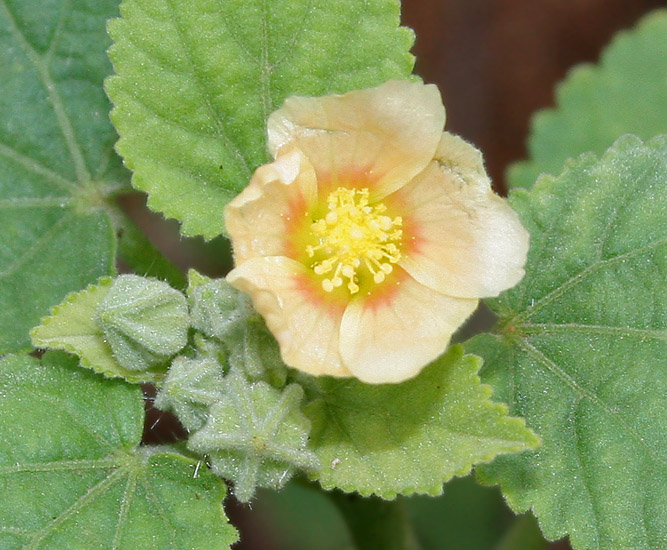
_in_Hyderabad%2C_AP_W_IMG_9420.jpg)
Bala is a small mallow whose root Ayurveda has long valued for building strength. Its name says it plainly, and the tradition reaches for it whenever the body is worn thin or the nerves are unsettled.
- Botanical name
- Sida cordifolia
- Family
- Malvaceae
- Sanskrit
- बला
- Part used
- Root
- Taste (rasa)
- Sweet (madhura)
- Quality (guna)
- Light, oily and a little slimy (laghu, snigdha, picchila)
- Energy (virya)
- Cooling (shita)
- After digestion (vipaka)
- Sweet (madhura)
- Action (karma)
- Builds strength and settles Vata (balya, vatahara)
- Best known for
- Building strength and steadying Vata
What is Bala?
Bala is the root of a small mallow, Sida cordifolia, a knee-high plant with heart-shaped leaves and little yellow flowers that grows wild across the warm parts of India. It is an unassuming weed of roadsides and open ground. The root is what Ayurveda values, dried and made into powder, decoction or medicated oil.
The name tells you everything. Bala means strength. The classical writers gave the plant this name for a reason, and for centuries it has been one of the herbs most reached for when a person needs building back up.
What Ayurveda uses it for
Ayurveda places Bala among its balya herbs, the strengthening group. Charaka lists it not once but several times, under strengthening, nourishing and tissue-building, which is unusual and tells you how highly the early writers thought of it.
The situation the texts describe is a familiar one: a body that is depleted, dry and tired. After long illness, hard work or simply the dryness that comes with age, when the wind-like quality the tradition calls Vata has risen and the frame feels light, restless and worn. Bala is brought in to feed and ground such a person, to settle the restlessness and slowly rebuild strength.
It is also one of the great oil herbs. A very large number of classical medicated oils carry Bala as their backbone, which is why the same root name appears again and again across the tradition.
Its qualities, in plain words
Ayurveda describes every herb by a short list of qualities, and Bala’s are easy to read. It is sweet, and in Ayurveda sweet means nourishing, the taste that builds tissue rather than wearing it down. It is cooling, so it suits heat and irritation rather than adding to them. And it is oily and slightly slimy, which is exactly the opposite of the dry, rough quality of disturbed Vata.
Put those together and you have a herb that nourishes, calms and moistens at the same time. That is why the tradition pairs it so naturally with the settling of Vata, and why it sits so comfortably in oils and milk-cooked preparations.
How it is taken
Bala is taken in several classical forms. As a root powder it is stirred into warm milk, in the same way as other strengthening roots. As a decoction it is taken by the cupful. Most famously it is cooked into medicated oils, where it is the central ingredient of well-known Vata-settling preparations, and into oils cooked with milk that are used both on the body and as Nasya, the gentle instillation through the nose.
Like other building herbs, Bala belongs to the slow side of Ayurveda. It is taken as a course over weeks, as nourishment, not as a single dose for a single day.
Good to know
There are three related plants in this group that the old texts distinguish: Bala, Atibala and Mahabala. They are close cousins and used in similar ways, with Bala the most commonly named.
This entry describes the classical Ayurvedic understanding of the herb. It is not medical advice, and anyone with a health condition should speak to a qualified practitioner.
Frequently asked
Why is Bala used in so many oils? Because its qualities, sweet, cooling, oily and strengthening, are the exact qualities the tradition wants for settling Vata, and oil is the classical vehicle for that work. Bala became the natural backbone for a whole family of medicated oils.
Which part of the plant is used? Mainly the root. The whole plant has some traditional use, but the root carries the strengthening reputation.
Is Bala the same as Atibala? No, though they are close relatives in the same family and used in similar ways. Bala is Sida cordifolia, while Atibala is Abutilon indicum.
Bala is sweet, cooling and strengthening, and it settles the wind that has gone astray.
After the Bhavaprakasha Nighantu, on Bala
Frequently asked questions
What is Bala herb used for?
Bala, whose name means strength, is used in Ayurveda to rebuild the body and settle the dry, restless quality of Vata. Its karma is described as balya and vatahara, so the tradition turns to the root, botanically Sida cordifolia, as a strengthening tonic during depletion and convalescence and in preparations aimed at the muscles and nerves.
What does Bala mean in Sanskrit?
Bala is the Sanskrit word for strength, and the herb takes its name directly from its reputation as a builder of the body. The root, Sida cordifolia, is classed as balya, strength-giving, with a sweet taste (madhura) that nourishes the tissues. This is why Bala anchors so many strengthening and Vata-settling classical formulations.
Which dosha does Bala balance?
Bala primarily settles Vata. Its sweet, nourishing, building quality (madhura, balya, vatahara) counters the dryness, depletion and restlessness of aggravated Vata, which is why it appears in oils and tonics for the muscles, joints and nerves. As a building herb it is less suited to heavy Kapha states, which need lightening rather than nourishing.
How is Bala taken in Ayurveda?
Bala is used in several forms: the root powder taken with milk or ghee, decoctions, and above all medicated oils such as Balaristam and Bala-based Thailams for external Abhyanga. The nourishing forms are chosen for building strength and settling Vata. Dose and preparation should follow a qualified Ayurvedic practitioner, especially when used as an internal tonic.
Is Bala good for strength and stamina?
Yes, this is exactly what the tradition prizes Bala for. Classed as balya, its very name means strength, and Ayurveda uses it to rebuild the body during weakness, depletion and recovery, and to steady an aggravated Vata. It is framed as a nourishing, strengthening tonic in classical terms rather than a modern performance supplement.
References
- Charaka Samhita, Sutrasthana, on the strengthening (balya) group of herbs.
- Sushruta Samhita, on the Vidarigandhadi group of nourishing roots.
- Bhavaprakasha Nighantu, Guduchyadi Varga, entry on Bala.