Materia Medica · Dravyaguna
Aragvadha
Cassia fistula · Fabaceae
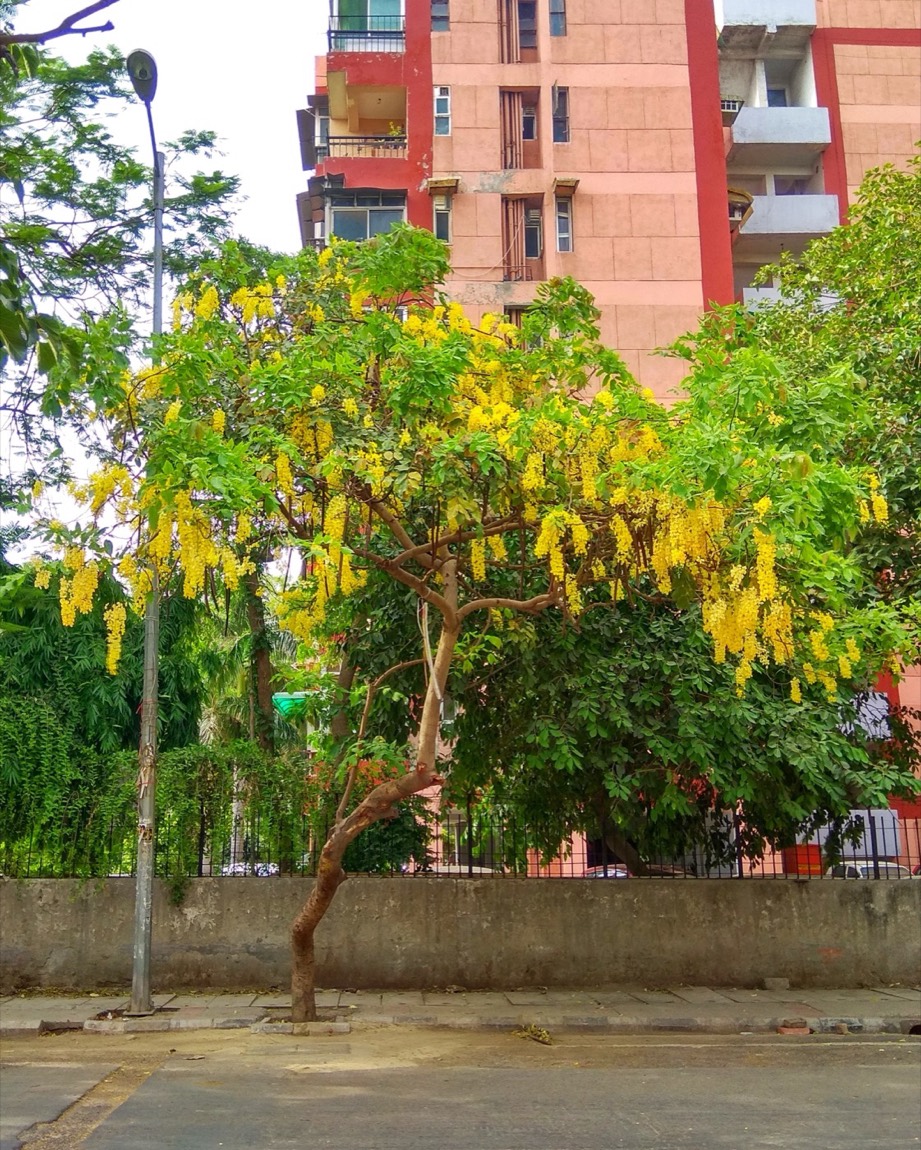

Aragvadha is the fruit pulp of the golden shower tree, whose long dark pods hang beneath sprays of yellow flowers. Ayurveda reaches for it as its gentlest purgative, a mild opener of the bowels that the tradition also links with the skin.
- Botanical name
- Cassia fistula
- Family
- Fabaceae
- Sanskrit
- आरग्वध
- Part used
- Ripe fruit pulp (leaf and flower also used)
- Taste (rasa)
- Sweet and bitter (madhura, tikta)
- Quality (guna)
- Heavy, unctuous and soft (guru, snigdha, mridu)
- Energy (virya)
- Cooling (sheeta)
- After digestion (vipaka)
- Sweet (madhura)
- Action (karma)
- Gently loosens the bowels, works on the skin, settles Pitta and Kapha (rechana, kushthaghna)
- Best known for
- A gentle classical purgative and a herb for the skin
What is Aragvadha?
Aragvadha is the fruit pulp of the golden shower tree, Cassia fistula, a handsome tree of the legume family that grows across the warm country of India. In flower it is hard to miss, hung with long trailing sprays of bright yellow blossom. After the flowers come the fruits: long, cylindrical, dark brown pods, sometimes as long as a forearm, and it is the soft dark pulp inside these ripe pods that Ayurveda has long used.
The names given to the tree pull in two directions. Aragvadha itself carries the sense of a herb that drives out disorder, a nod to its loosening, clearing action. The gentler names look instead at its beauty and worth: Rajavriksha means the royal tree, and Suvarnaka means the golden one, both drawn from those cascading golden flowers. In India it is widely known as Amaltas, and English speakers call it the golden shower tree, the Indian laburnum, or the purging cassia.
What Ayurveda uses it for
Aragvadha belongs above all to the group of gentle purgatives. The classical writers count it among the herbs that loosen the bowels, an action the tradition calls rechana, and what marks it out is the mildness of that action. Where many purging herbs are strong and drying, Aragvadha is soft and cooling, and for this reason the tradition allows it in places where a stronger herb would be held back: for the weak, for the elderly, and in pregnancy under guidance. The Sushruta Samhita gives it the honour of naming a whole group of herbs after it, the Aragvadhadi gana, and it is often linked in the texts with disorders of the skin, an action described as kushthaghna.
Within that role the dravyaguna texts describe the fruit pulp as traditionally indicated in a familiar set of conditions, each named here in its classical Sanskrit term with a plain gloss:
- Vibandha: constipation, its famous gentle action, mild enough that the tradition allows it for the weak, the elderly and in pregnancy under guidance.
- Udara: abdominal distension, where its loosening, opening quality is called upon.
- Kushtha: the broad classical category of skin disorders, the action the texts call kushthaghna.
- Jwara: fever, for which its cooling nature is noted.
- Vatarakta: a classical disorder of the blood and the joints.
- Gulma: abdominal masses, among the conditions of the belly for which it is described.
These are the traditional textual indications recorded in the classical literature. They set out how Ayurveda has long understood the herb and are given for reference and study, not as statements of medical effect or as advice to treat any condition.
Its qualities, in plain words
Ayurveda describes every herb by a short list of qualities, and for Aragvadha they explain its unusually gentle character.
Its taste is sweet, with a bitter edge, and in Ayurveda a sweet taste is the taste of nourishment while a bitter one is cleansing and cooling. It is heavy, unctuous and soft, so rather than scraping or drying the body it moves it gently, the softness in particular setting it apart from the harsher purgatives. It is cooling, which is why the texts turn to it where there is heat, and why it settles the fiery Pitta dosha. And it finishes sweet after digestion, a sign that it does not wear the body down as it works. Put together, these qualities describe a soft, cool, gently loosening herb, which is why the tradition settles on its action of easing the bowels without force and pacifying both Pitta and Kapha.
How it is taken
The classical form is the ripe fruit pulp, scooped from the dark pod. It is soft on its own and is often simply mixed into warm water or dissolved out of the pod, a plain preparation that suits its plain, gentle action. The leaf and the flower are also described in the classical literature, though it is the fruit pulp that nearly all of its named preparations call for.
From that pulp the classical writers made a small number of well-known preparations. Aragvadha gives its name to Aragvadharishta, a fermented liquid preparation, and to Aragvadhadi Kashaya, also known as Aragvadhadi Kwatha, a classical decoction in which the pulp sits alongside other herbs. As a soft, cooling opener it was valued in these forms for a measured, unhurried action rather than a forceful one.
Good to know
Aragvadha is one of the gentle, loosening herbs, and its whole reputation rests on that gentleness: it is the purgative the tradition names when a milder touch is wanted, soft enough that the classical writers allowed it where they would hold back a stronger herb. It belongs to the clearing rather than the building side of Ayurveda, but it clears without the drying force of the harsher herbs, which is the quality that has kept it in use for so long.
This entry describes the classical Ayurvedic understanding of the herb. It is not medical advice, and anyone with a health condition should speak to a qualified practitioner.
Frequently asked
Why is Aragvadha called the gentlest purgative? Because its loosening action, which the tradition calls rechana, is soft and cooling rather than strong and drying. Its qualities are heavy, unctuous and above all soft (mridu), and this mildness is why the classical writers allowed it for the weak, the elderly and in pregnancy under guidance, where a stronger herb would be held back.
Which part of the plant is used? Chiefly the ripe fruit pulp, taken from the long dark pods. The leaf and the flower are also described in the classical literature, but the pulp is the part named for nearly all of its preparations.
Why is it linked with the skin? The classical texts count Aragvadha among the herbs described as kushthaghna, acting on Kushtha, the broad Ayurvedic category of skin disorders. This is a traditional textual classification, recorded for reference and study rather than as a statement of medical effect.
Aragvadha is sweet and cooling; it loosens the bowels gently and is counted among the herbs that clear disorders of the skin.
After the Bhavaprakasha Nighantu, on Aragvadha
Its purging action is mild, and for that reason the tradition allows it where a stronger herb would not be given.
After the classical dravyaguna account of the gentle purgatives
Frequently asked questions
What is Aragvadha used for?
Aragvadha, the ripe fruit pulp of the golden shower tree (Cassia fistula), is valued in Ayurveda as its mildest classical purgative. The texts class it as rechana, gently loosening the bowels, and as kushthaghna for the skin. It is understood to settle Pitta and Kapha and is gentle enough that the tradition allows it for the weak and elderly.
Is Aragvadha a gentle laxative?
Yes. Aragvadha is prized precisely because it is the mildest of the classical purgatives, its sweet and bitter fruit pulp working gently enough that the tradition permits it even for those who are weak or elderly. Even so, purgatives are taken deliberately and by the right dose, so it is best used under a practitioner's guidance.
What part of Cassia fistula is used in Ayurveda?
It is the ripe fruit pulp of Cassia fistula, the golden shower tree, that Ayurveda uses as Aragvadha, also known as Amaltas or Rajavriksha. This soft pulp inside the long pods carries the herb's gentle rechana, bowel-loosening action, and is the part the classical texts specify for its mild purgative use.
Is Aragvadha good for the skin?
Alongside its gentle purgative role, Aragvadha is classed as kushthaghna, a herb that works on the skin, and it settles Pitta and Kapha, the Doshas Ayurveda often links with skin heat and congestion. It appears in this role within the tradition and is offered as traditional support rather than a treatment for any named condition.
Who can take Aragvadha?
Because it is so mild, Ayurveda regards Aragvadha as suitable even for the weak and the elderly, which sets it apart from stronger purgatives. That said, any bowel-loosening herb should be taken by the right dose and not casually, so use it under a qualified Ayurvedic practitioner, and consult a doctor in pregnancy.
References
- Charaka Samhita, Sutrasthana, among the herbs listed for gentle purgation (mridu virechana).
- Sushruta Samhita, among the Aragvadhadi gana, the group of herbs named after this plant.
- Bhavaprakasha Nighantu, entry on Aragvadha (Rajavriksha) with its synonyms and properties.
- Raja Nighantu, listing the many Sanskrit synonyms of the tree, including Suvarnaka.