Materia Medica · Dravyaguna
Prishnaparni
Uraria picta · Fabaceae (Leguminosae)
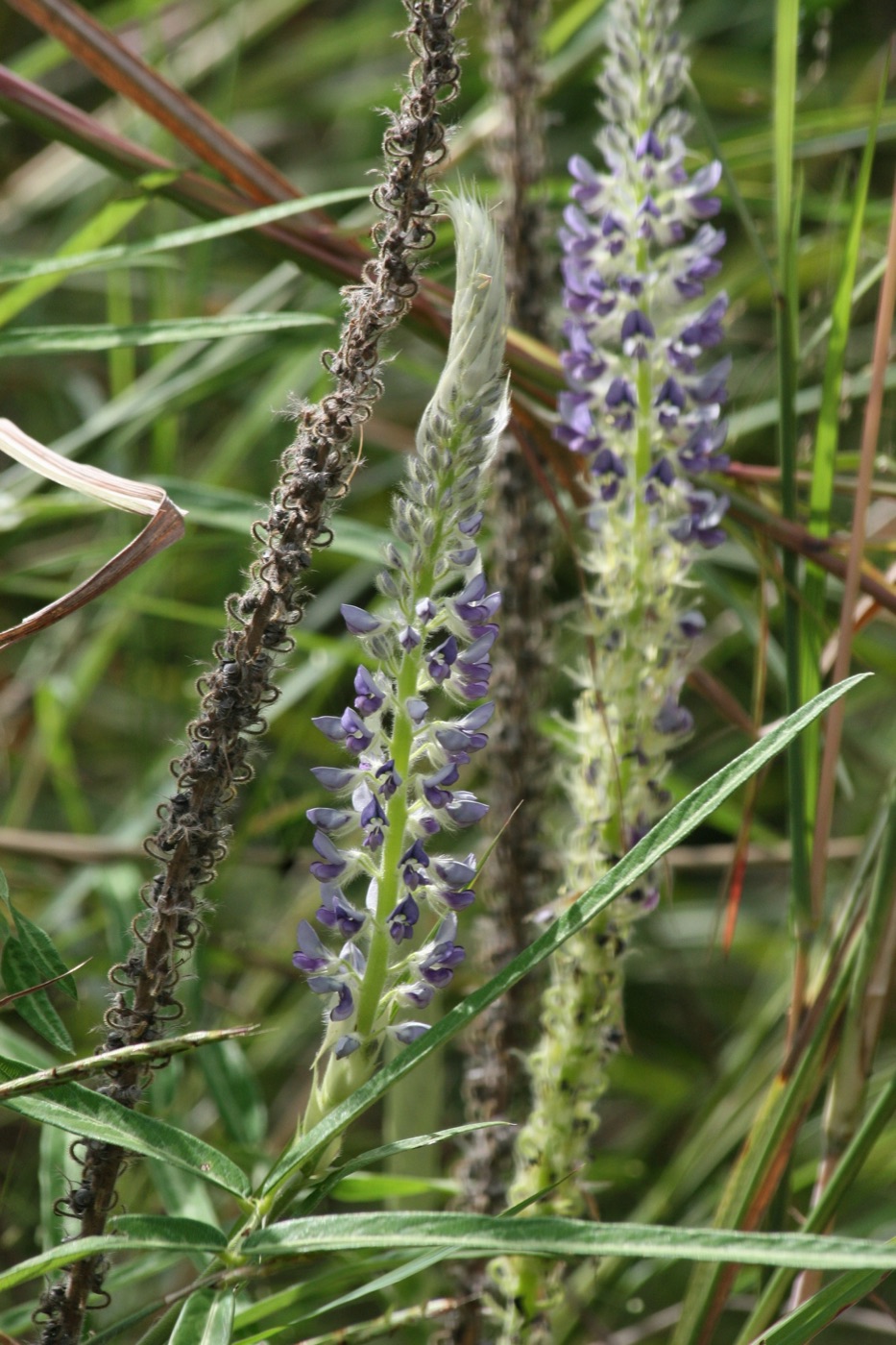

Prishnaparni is a small legume of the Fabaceae family whose root is counted among the ten roots of the celebrated Dashamoola group. In the classical texts it belongs to the smaller five roots, the Laghu Panchamoola, and is described as a sweet, warming dravya used to support strength and to settle Vata.
- Botanical name
- Uraria picta
- Family
- Fabaceae (Leguminosae)
- Sanskrit
- पृश्निपर्णी
- Part used
- Root (mula)
- Taste (rasa)
- Sweet and bitter (madhura, tikta)
- Quality (guna)
- Light and unctuous (laghu, snigdha)
- Energy (virya)
- Warming (ushna)
- After digestion (vipaka)
- Sweet (madhura)
- Action (karma)
- Strengthening and grounding, settling to Vata (balya, vatahara)
- Best known for
- one of the five lesser roots of the Dashamoola group
What is Prishnaparni?
Prishnaparni is a slender legume of the Fabaceae family, the same botanical family as peas and beans. In classical Ayurveda it is placed in the Simbi kula, the group of pod-bearing plants. The part that Ayurveda values most is the root, or mula, which is one of the ten roots that make up the Dashamoola group.
The Sanskrit name paints a small picture in itself. Prishnaparni can be read as “the one with spotted or dappled leaves”, a reference to the marked pattern on the foliage. The plant carries a long list of traditional synonyms too, including Prithakparni, Chitraparni, Simhapuchhika and Kalashi, each pointing to a feature of its leaf, form or appearance. In several Indian languages it is known by the vernacular name Pitvan.
A point worth noting from the outset is that the name Prishniparni has been used in Ayurvedic practice for more than one plant. The Ayurvedic Pharmacopoeia of India and much of North India accept Uraria picta, which is the identity used here, while a good deal of practice in South India and Kerala uses Desmodium gangeticum under the same name. This is a genuine and well documented point about botanical identity rather than a small footnote, and it is one reason the herb is treated with care in sourcing.
What Ayurveda uses it for
Prishnaparni is best understood through its place in the Dashamoola, the “ten roots”. These ten are divided into two sets: the five greater roots, the Brihat Panchamoola, and the five lesser roots, the Laghu Panchamoola. Prishnaparni belongs to the lesser five, standing alongside Shalaparni, Brihati, Kantakari and Gokshura.
Within the classical framework it is described as a strengthening and grounding dravya. The Ayurvedic texts group it among substances traditionally regarded as balya, meaning strengthening, and as a herb that settles the movement of Vata. It is also associated in the classics with sangrahika and sandhaniya qualities, traditional terms for consolidating fluids and for knitting or bringing tissue together. It is described as tridoshahara, that is, balancing to all three doshas, with its clearest traditional action being on Vata.
Because it is a Dashamoola constituent rather than a herb usually taken on its own, its traditional role shows up most often through the larger group. Wherever Dashamoola appears in classical restorative and Vata-settling preparations, Prishnaparni is one of the quiet contributors. This is a description of its traditional role and is not a health claim.
Its qualities, in plain words
Ayurveda describes every herb through a small set of qualities, and Prishnaparni has a clear profile.
Its rasa, or taste, is madhura and tikta, sweet and bitter together. The sweet side lends a nourishing, settling character, while the bitter side keeps it from being heavy or cloying.
Its guna, the physical qualities, are laghu and snigdha, light and unctuous. Think of it as light to carry yet with a smooth, oily touch, a combination that suits a herb meant to steady rather than to burden.
Its virya, the potency or the felt temperature, is ushna, warming. In the Ayurvedic view a warming herb gently encourages movement and circulation, which is part of why Prishnaparni is traditionally seen as settling to Vata, the dry and mobile dosha.
Its vipaka, the taste that remains after digestion is complete, is madhura, sweet. A sweet vipaka is traditionally linked with the nourishing, building end of the spectrum, and it rounds out the picture of a herb valued for strength and grounding.
How it is taken
In practice Prishnaparni is almost always used as part of the Dashamoola root group rather than as a single herb. The roots are commonly prepared as a kwatha, a water decoction in which the roots are simmered, and as an arishta, a traditionally fermented preparation. Dashamoola also serves as a base for medicated oils, or taila.
You will find Prishnaparni, through Dashamoola, in a number of named classical formulations. It is part of the base of Dashamoolarishtam and Dashamoola Kwatha, and it appears in the well known medicated oils Mahanarayana Taila and Dhanwantaram Thailam, as well as in the classical preparation Manasamitra Vatakam. In each of these it works alongside many other herbs, its role being to lend the strengthening and grounding character described above rather than to act alone.
Good to know
Because Prishnaparni is used within larger polyherbal formulations, the way it is taken, the vehicle it is carried in and the length of any course are matters for a qualified practitioner rather than fixed rules. Traditional practice pays attention to the person and the season as much as to the herb itself.
There is also the botanical-identity caution mentioned earlier. Since the name Prishniparni is applied to more than one plant, material sold under this name should be correctly identified before any use, so that what is in the jar matches what is intended.
This entry describes the classical Ayurvedic understanding of the herb. It is not medical advice, and anyone with a health condition should speak to a qualified practitioner. Anyone who is pregnant or breastfeeding should do the same before use.
Frequently asked
Is Prishnaparni the same as Shalaparni? No, though the two are close companions. Both are among the five lesser roots of the Laghu Panchamoola and are often named together in the classical texts, but they are distinct plants with their own descriptions.
Why is there confusion about which plant Prishnaparni is? The Sanskrit name has been applied to more than one botanical species over time. The Ayurvedic Pharmacopoeia of India and North Indian practice accept Uraria picta, while South Indian and Kerala practice often uses Desmodium gangeticum. This is a real, documented point, which is why correct identification of the material matters.
Is Prishnaparni usually taken on its own? Rarely. It is valued chiefly as one of the ten roots of Dashamoola and is used within classical polyherbal preparations such as decoctions, fermented arishtas and medicated oils rather than as a single herb.
Prishnaparni is placed among the roots grouped for their strengthening and consolidating qualities and for settling the movement of Vata.
After the Charaka Samhita, Sutrasthana
Prishnaparni is counted within the Vidarigandhadi and Haridradi groups of roots and herbs.
After the Sushruta Samhita
Prishnaparni is described among the sweet, grounding dravyas of the Guduchyadi group.
After the Bhavaprakasha Nighantu
Frequently asked questions
What is Prishnaparni used for in Ayurveda?
Prishnaparni, from Uraria picta, is a slender legume whose root is one of the ten classical roots of Dashamoola, counted among the five lesser roots. Valued as a strengthening and grounding herb, the texts class it as balya and vatahara, so it is traditionally used to settle Vata and steady the body, mostly through the Dashamoola group.
Is Prishnaparni part of Dashamoola?
Yes. Prishnaparni is one of the ten roots of Dashamoola and belongs to the Laghu Panchamoola, the five lesser roots of that group. Its sweet, bitter, grounding root contributes to the Vata-settling, strengthening character of the collection, which is why Prishnaparni is met most often within Dashamoola decoctions and tonics rather than as a herb given on its own.
What are the qualities of Prishnaparni?
Prishnaparni has a sweet and bitter taste and a grounding, strengthening, Vata-settling nature, which the texts capture in classing it as balya and vatahara. These qualities make it a steadying, nourishing root well suited to dry, mobile, depleted Vata states. Its role is chiefly collective, lending those qualities to the wider Dashamoola group of formulas.
What is the Laghu Panchamoola?
Laghu Panchamoola means the five lesser, or lighter, roots, one of the two halves of Dashamoola, the other being the five greater roots. Prishnaparni is one of these five lesser roots. As a group they are lighter and more grounding, and Ayurveda uses them, within Dashamoola, chiefly to settle Vata and steady and strengthen the body.
Which dosha does Prishnaparni balance?
Prishnaparni chiefly settles Vata, in keeping with its sweet, grounding, strengthening nature and its balya, vatahara classing. Its steadying quality answers the dry, cold, mobile character of aggravated Vata. In practice this action is expressed mainly through the Dashamoola group, the classical Vata-settling collection of which Prishnaparni is one of the ten roots.
References
- Charaka Samhita, Sutrasthana (Angamardaprashamana, Sandhaniya and Shothahara mahakashaya)
- Sushruta Samhita (Vidarigandhadi and Haridradi gana)
- Ashtanga Hridaya and Ashtanga Sangraha, Vagbhata (Haridradi gana)
- Bhavaprakasha Nighantu (Guduchyadi varga)
- Raja Nighantu and Dhanvantari Nighantu (synonym and property compilations)