Materia Medica · Dravyaguna
Kampillaka
Mallotus philippensis · Euphorbiaceae
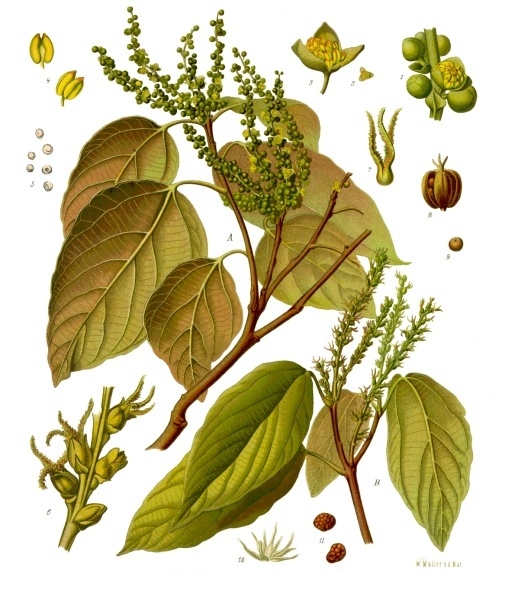

Kampillaka is the red glandular powder that coats the ripe fruit of a small tree. Ayurveda ranks it among its leading worm-clearing herbs, and the same red powder has long served as a dye.
- Botanical name
- Mallotus philippensis
- Family
- Euphorbiaceae
- Sanskrit
- कम्पिल्लक
- Part used
- Red glandular powder from the surface of the fruit
- Taste (rasa)
- Pungent and bitter (katu, tikta)
- Quality (guna)
- Dry, penetrating and light (ruksha, tikshna, laghu)
- Energy (virya)
- Warming (ushna)
- After digestion (vipaka)
- Pungent (katu)
- Action (karma)
- Clears worms, purges and clears the skin, settles Kapha (krimighna, rechana, kushthaghna)
- Best known for
- The classical red powder for clearing intestinal worms
What is Kampillaka?
Kampillaka is not a root, a bark or a berry in the usual sense, but a fine powder gathered from the surface of a fruit. It is collected from Mallotus philippensis, a small tree of the spurge family that grows across the hills and forests of India. When the small round fruits ripen, their outer surface is covered in a coat of tiny red glands. Brushed or rubbed from the fruit, these glands yield a light, bright red powder, and it is this red powder, and not the wood or the leaf, that Ayurveda has long valued.
The Sanskrit tradition gives the herb several names that turn on that colour. It is called Raktanga, “the red-limbed one”, and Chandra, among other synonyms recorded in the Nighantu literature. In common use it is known as Kampillaka or Kamala, and the tree is sometimes called the kamala tree or the monkey-face tree. In English it also carries the old name Dyer’s rottlera, a plain record of its second life: long before its medicinal use was written down, the same red powder was used to dye cloth a warm orange-red.
What Ayurveda uses it for
Kampillaka’s place in the classical texts is fixed and clear. Its foremost use is as a krimighna herb, one of the substances Ayurveda reaches for to clear Krimi, the classical category of intestinal worms. The tradition counts it among the leading herbs of this kind, and in the old accounts it is associated in particular with the tape-worm. Its dry, penetrating, warming nature was understood to make the gut unwelcoming to such organisms and to help carry them out of the body.
That expelling work is closely tied to its second action, rechana, a purgative, downward-moving effect that clears the belly. The two go together in the classical picture: the herb loosens and moves what is to be cleared. Alongside this, the dravyaguna texts place Kampillaka among the kushthaghna herbs, those addressed to Kushtha, the broad classical class of skin disorders, and they note its application to wounds.
Within that role the classical writers describe Kampillaka as traditionally indicated in a familiar set of conditions, each named here in its classical Sanskrit term with a plain gloss:
- Krimi: the classical category of intestinal worms, the herb’s foremost use, and the tape-worm in particular in the tradition.
- Udara: distension and swelling of the abdomen, where its clearing, downward-moving action is called upon.
- Vibandha: constipation, given its purgative rechana quality.
- Kushtha: the broad class of skin disorders, for which it is counted among the kushthaghna herbs.
- Vrana: wounds, to which the red powder was applied externally.
These are the traditional textual indications recorded in the classical literature. They set out how Ayurveda has long understood the herb and are given for reference and study, not as statements of medical effect or as advice to treat any condition.
Its qualities, in plain words
Ayurveda describes every herb by a short list of qualities, and Kampillaka’s explain its work plainly.
Its taste is pungent, with a bitter edge, and both of these are clearing, drying tastes rather than nourishing ones. It is dry, penetrating and light, so instead of feeding or grounding the body it scrapes and reaches inward, lifting the heavy, sticky quality the texts dislike. It is warming, which suits a herb whose task is to clear rather than to cool. And it finishes pungent after digestion, a sign that it keeps working in the same direction, clearing rather than clogging. Put together, this is a herb that warms, dries, penetrates and moves, which is exactly why the tradition hands it the worm-clearing and purging work.
These same qualities mean it settles the cold, heavy quality the tradition calls Kapha. Because it is warming, drying and downward-moving, it is used thoughtfully, in small measure, and not as an open-ended habit.
How it is taken
The part used is the red glandular powder itself, the kapila rajah brushed from the surface of the ripe fruit. Because it comes already as a fine powder, it needs little preparation, and the simplest classical form is that powder taken in a small, measured dose, often with a suitable vehicle to carry its action.
Kampillaka appears by name in krimighna formulations, the worm-clearing preparations of the classical repertoire, where its expelling and purging action is wanted. In keeping with its purgative nature, it is commonly paired with other clearing and downward-moving herbs, so that the loosening and the moving work together. It belongs firmly to the clearing, purging side of the herb cabinet rather than the cooling or the building side.
Good to know
Kampillaka is a potent substance. The tradition treats it as a strong drug, used in a small measure and under the guidance of a qualified practitioner, rather than as a gentle everyday herb. Its purgative, downward-moving nature is exactly why the old writers were careful with the dose, and why it belongs to the clearing rather than the nourishing side of Ayurveda. One further point is worth noting: the same red powder has long been used as a dye, and this dual history, as a colouring agent and as a medicine, is part of what the classical record preserves.
This entry describes the classical Ayurvedic understanding of the herb. It is not medical advice, and anyone with a health condition should speak to a qualified practitioner.
Frequently asked
Which part of the plant is used? The red glandular powder that coats the surface of the ripe fruit. It is not the wood, the leaf or the root that is valued, but this fine red powder, brushed from the fruit, which the tradition calls the red powder of the fruit and knows as kapila rajah.
Why is it also known as a dye? Because the same red powder that Ayurveda uses as a medicine has long been used to colour cloth a warm orange-red. The old English name Dyer’s rottlera records this second use, and the Sanskrit synonyms such as Raktanga, “the red-limbed one”, turn on the same colour.
Why do the texts treat it as a strong herb? Because it is a potent, purgative substance with a warming, penetrating, downward-moving action. The classical writers used it in a small measure and for the clearing of worms, and the tradition places it among the strong drugs to be given with care.
Kampillaka is pungent and warming; it clears the worms, moves the belly and settles the Kapha dosha.
After the Bhavaprakasha Nighantu, on the worm-clearing herbs
Among the herbs that expel the worms of the belly, Kampillaka is counted a leading one.
After the classical Nighantu tradition, on the krimighna substances
Frequently asked questions
What is Kampillaka used for?
Kampillaka is a fine red powder gathered from the surface of the small fruit of Mallotus philippensis. Ayurveda counts it among its foremost herbs for clearing intestinal worms. The texts class its action as krimighna, worm-clearing, rechana, purging, and kushthaghna, skin-clearing, and it is used to settle Kapha as well.
How does Kampillaka work against worms?
Its pungent and bitter qualities give it a strong krimighna, or worm-clearing, action in the classical texts, often paired with a mild purging, rechana, effect that helps expel what has been dislodged. This is why Ayurveda ranks it among the leading herbs for intestinal worms. It is a potent purgative herb used in measured, guided doses.
Is Kampillaka the red powder used as a dye?
Yes. The same fine red powder from the fruit surface of Mallotus philippensis, sometimes called Kamala, has long been used as a natural dye as well as a medicine. In Ayurveda its medicinal use centres on clearing worms and, applied externally, on the skin. The dye and the herb are one and the same substance.
How do you take Kampillaka?
It is taken as a small, carefully measured dose of the powder, often with a suitable anupana, because it carries a purging action. Given that potency, both the dose and the timing should be set by a qualified Ayurvedic practitioner rather than self-prescribed, and it is used as a short, targeted course rather than routinely.
Is Kampillaka safe to use on your own?
No. Because it is a potent worm-clearing and purging herb, Kampillaka is not a casual remedy and can cause strong bowel action if misused. It is generally avoided in pregnancy, in children and in the frail unless a practitioner directs it. Use it only under a qualified Ayurvedic practitioner and mention it to your doctor if you take other medication.
References
- Charaka Samhita, Chikitsasthana, in the treatment of Krimi (intestinal worms), where cleansing and purging measures are described.
- Sushruta Samhita, among the substances used against Krimi and in the treatment of Kushtha (skin disorders).
- Bhavaprakasha Nighantu, entry on Kampillaka (Kamala) with its properties and its worm-clearing and purgative action.
- Raja Nighantu, listing the Sanskrit synonyms of the plant, among them Raktanga and Chandra.
- Dhanvantari Nighantu, on the red powder of the fruit and its uses.