Materia Medica · Dravyaguna
Gambhari
Gmelina arborea · Lamiaceae
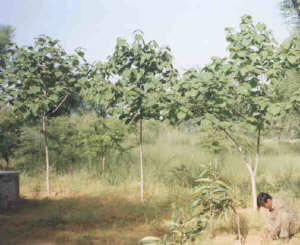

Gambhari is a tall forest tree whose root Ayurveda numbers among the five great roots of the Dashamoola. The root is reached for to steady the digestion and settle heat and swelling, while its sweet fruit carries a quieter reputation for nourishment.
- Botanical name
- Gmelina arborea
- Family
- Lamiaceae
- Sanskrit
- गम्भारी
- Part used
- Root and root bark
- Taste (rasa)
- Bitter, astringent and sweet (tikta, kashaya, madhura)
- Quality (guna)
- Heavy (guru)
- Energy (virya)
- Warming (ushna)
- After digestion (vipaka)
- Pungent (katu)
- Action (karma)
- Settles swelling and heat, kindles the digestion (shothahara, deepana)
- Best known for
- One of the great roots of the classical Dashamoola group
What is Gambhari?
Gambhari is a large deciduous tree, Gmelina arborea, that grows across the forests of India. It stands tall, with a pale trunk, broad heart-shaped leaves and yellow-brown flowers that give way to smooth yellow fruit. In English it is sometimes called white teak or the Kashmir tree, and its light-coloured timber is well known outside medicine. In Ayurveda, though, it is the root and root bark that are asked for first, with the fruit valued in its own right.
The tree carries a whole family of Sanskrit names, among them Kashmari, Sriparni and Madhuparnika. Several of these speak of leaves and of sweetness, and the sweetness is a real clue: the wholesome, honey-like quality of the fruit is part of the reputation this tree has carried for a very long time.
What Ayurveda uses it for
Gambhari’s best-known place is inside a group rather than on its own. Its root is one of the Dashamoola, the “ten roots”, and more particularly one of the Brihat Panchamoola, the five great roots drawn from larger trees. This set of roots sits at the base of a great many classical formulas, so the name Gambhari turns up across the tradition wherever the Dashamoola is used.
On its own the root is described in a few settings. It is counted among the shothahara herbs, those the texts reach for to help settle swelling, and among the dahaprashamana herbs, used to soothe a burning quality. It is also spoken of as deepana and pachana, meaning it supports the appetite and the digestion. Classical writers set it, on the whole, as a herb that steadies Vata and Pitta together, the dry, restless quality and the hot, sharp one.
The fruit tells a gentler story. Sweet and wholesome, it is traditionally described as nourishing, as Rasayana or rejuvenating, and as Medhya, supportive of the mind. Where the root is a working ingredient of larger formulas, the fruit carries the quiet reputation of a nourishing food.
Its qualities, in plain words
Ayurveda describes every herb by a short list of qualities, and Gambhari’s are worth reading slowly, because they pull in more than one direction.
In taste it is bitter, astringent and sweet all at once, an unusual mix that lets it both clear and nourish. It is warming in potency, which is why the tradition uses it to meet cold and to kindle a sluggish digestion. It is heavy, so it is thought of as substantial and grounding rather than light, and for that reason it is considered a little heavy to digest. And after digestion it finishes pungent, which keeps a stirring, warming edge to the end. Put together, this is a herb that grounds and warms while still carrying a sweet, nourishing note, which is why it settles both the dry restlessness of Vata and the heat of Pitta.
How it is taken
Gambhari is rarely taken alone. Its usual home is inside classical formulas, above all those built on the Dashamoola roots, where the root and root bark lend their share to the whole. The simplest traditional form is the Kashayam, a water decoction of the root, and the root also goes into medicated oils. It is one of the ten roots in Dashamoolarishta, a gently fermented tonic, and in Dashamoola Kashayam, and it sits among the roots at the heart of the classical oil Narayana Thailam.
The fruit is used differently. It is taken in powdered form and folded into nourishing preparations, in keeping with its reputation as a wholesome, building food rather than a working medicine.
Good to know
Because Gambhari is warming and heavy, the tradition treats it as grounding and substantial, and pairs it most naturally with the settling of Vata and Pitta. Its real value is as a team player: the Dashamoola roots are prized for what they do together, and Gambhari is one of the five great ones. Like other building ingredients, it belongs to the slow, steady side of Ayurveda and is taken as part of a considered course rather than as a single dose for a single day.
This entry describes the classical Ayurvedic understanding of the herb. It is not medical advice, and anyone with a health condition should speak to a qualified practitioner.
Frequently asked
What is the Dashamoola, and where does Gambhari fit? The Dashamoola is the classical group of ten roots, five from larger trees and five from smaller shrubs, brought together into one set that forms the base of many Ayurvedic preparations. Gambhari is one of the five great roots, the Brihat Panchamoola, drawn from the tree side of the group.
Is the fruit used as well as the root? Yes. The root and root bark are the main medicinal parts and the reason Gambhari belongs to the Dashamoola, but the sweet fruit has its own traditional use as a nourishing, wholesome food.
Which part of the plant is used? Chiefly the root and root bark. The fruit, and to a lesser extent the flower, leaf and bark, also have traditional use, but it is the root that carries Gambhari into the classical formulas.
Kashmarya is numbered among the herbs that settle swelling and soothe burning, and its sweet fruit is spoken of as wholesome and nourishing.
After the Charaka Samhita, on the herbs grouped for swelling and for burning
Sweet, astringent and bitter in taste, heating in potency and heavy in quality, Gambhari is set among the roots of the Brihat Panchamoola.
After the Bhavaprakasha Nighantu, on Gambhari
Frequently asked questions
What is Gambhari used for in Ayurveda?
Gambhari (Gmelina arborea) is a forest tree whose root is one of the great roots of the classical Dashamoola. Ayurveda values it to support digestion and to settle swelling and burning, classing its action as shothahara and deepana. It also bears a sweet, nourishing fruit. The root is used mainly within traditional decoctions rather than on its own.
Is Gambhari part of Dashamoola?
Yes. Gambhari is one of the five great roots (Brihat Panchamoola) that, with the five lesser roots, make up Dashamoola, the classical ten-root group. Within it, Gambhari contributes its digestion-kindling and swelling-settling character. Dashamoola decoctions are among Ayurveda's foremost Vata-settling preparations, and Gambhari (also called Kashmari) is a standard member of the greater roots.
What are the benefits of Gambhari?
Ayurveda associates Gambhari with settling swelling and heat (shothahara) and kindling the digestion (deepana), with a taste that is bitter, astringent and sweet. As a Dashamoola root it features in many classical decoctions, and its sweet fruit is counted among nourishing foods. Its benefits are framed in classical terms and are usually drawn out within compound formulations.
What part of the Gambhari tree is used?
Chiefly the root, which is why Gambhari is counted among the great roots of Dashamoola and carries its shothahara and deepana actions. The tree also yields a sweet, nourishing fruit that Ayurveda values as a restorative food. Bark is used in some contexts too, but it is the root that anchors its classical Dashamoola role.
What is another name for Gambhari?
Gambhari is also known as Kashmari in the classical texts, and botanically as Gmelina arborea. Under these names it appears as one of the great roots of Dashamoola. Knowing the synonyms helps when reading formulas, since a Dashamoola decoction may list the same root as Gambhari or Kashmari depending on the source.
References
- Charaka Samhita, Sutrasthana, on the herbs grouped for swelling (shothahara) and for burning (dahaprashamana).
- Sushruta Samhita, Sutrasthana, on the Sarivadi group and the Brihat Panchamoola roots.
- Ashtanga Hridayam, on the Sarivadi group of herbs.
- Bhavaprakasha Nighantu, Guduchyadi Varga, entry on Gambhari.
- Dhanvantari Nighantu, Guduchyadi Varga, entry on Gambhari.