Materia Medica · Dravyaguna
Devadaru
Cedrus deodara · Pinaceae
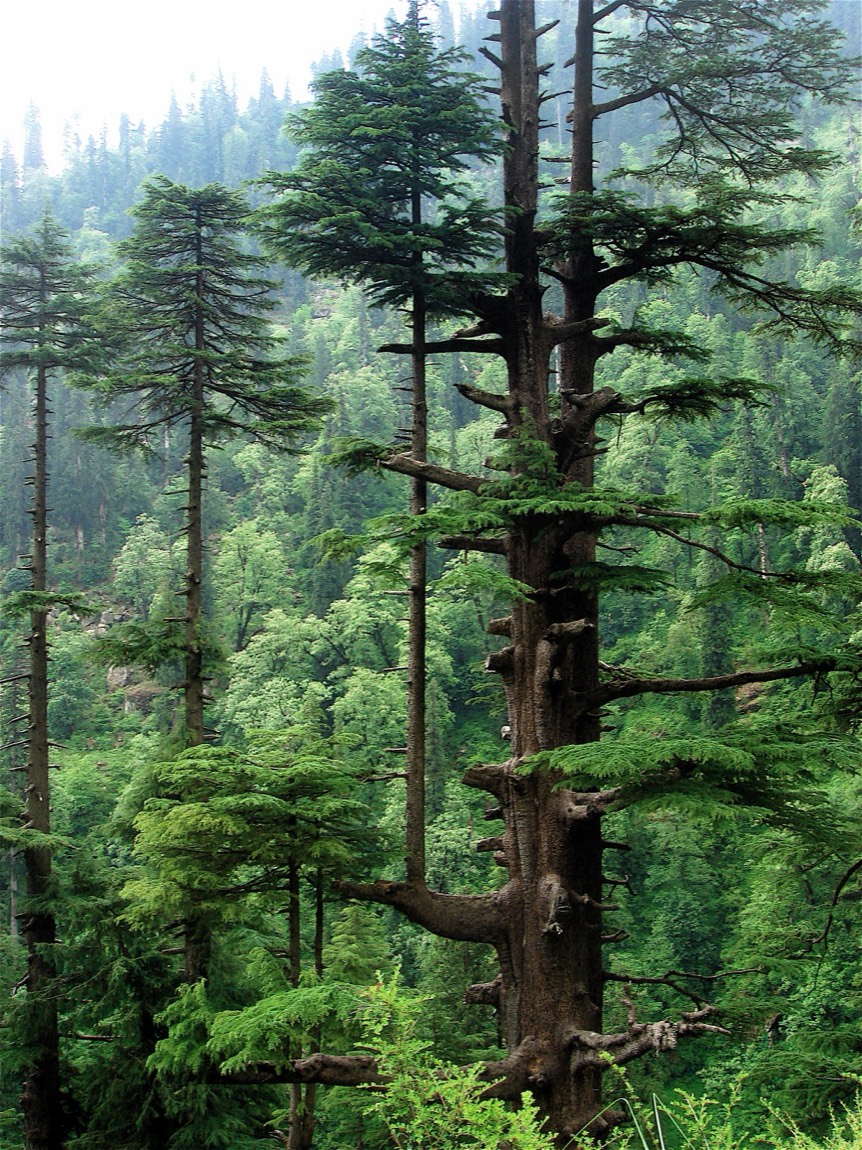

Devadaru is the heartwood of the Himalayan cedar, prized in Ayurveda for its warm, resinous quality. The name means the wood of the gods, and the tradition reaches for it when the body feels cold, damp and stagnant.
- Botanical name
- Cedrus deodara
- Family
- Pinaceae
- Sanskrit
- देवदारु
- Part used
- Heartwood
- Taste (rasa)
- Bitter, with a pungent edge (tikta, katu)
- Quality (guna)
- Light, dry and penetrating (laghu, ruksha, tikshna)
- Energy (virya)
- Warming (ushna)
- After digestion (vipaka)
- Pungent (katu)
- Action (karma)
- Settles Vata and Kapha, kindles digestion, clears stagnation (vatahara, kaphahara, deepana)
- Best known for
- The warming, aromatic cedar wood used to clear cold and stagnation
What it is
Devadaru is the heartwood of the Himalayan cedar, Cedrus deodara, a tall evergreen tree that grows on the cold slopes of the western Himalayas. The wood is pale gold to warm brown, and when it is freshly cut it gives off a sweet, resinous smell that is unmistakable.
The name is worth knowing. Deva means divine, and daru means wood, so Devadaru is the wood of the gods. The old writers used the cedar for incense and for building as well as for medicine, and the same fragrant resin that makes the wood last for a long time is what Ayurveda values in the body. It is the heartwood, dried and chipped or powdered, that goes into preparations.
What Ayurveda uses it for
Ayurveda reads Devadaru as a warming, drying herb. In the language of the doshas it settles both Vata, the cold and dry quality, and Kapha, the cold and heavy quality. So the tradition reaches for it in one clear picture: when the body feels cold, damp, heavy and stuck.
The texts place it among the bitter herbs that kindle the digestive fire and clear sluggishness. They also count it among the herbs for the skin, where its drying, clearing character is put to use. Its warm, aromatic quality made it a natural choice for the older formulas aimed at heaviness and stagnation rather than at heat. Devadaru is rarely the whole remedy. It is a supporting herb that lends its warmth and fragrance to a larger formula.
Its qualities, in plain words
Ayurveda describes every herb by a short list of qualities, and for Devadaru they line up neatly.
It is warming, which is why it suits the cold qualities of both Vata and Kapha. It is light, dry and penetrating, so it moves through the body and clears rather than feeds. Its taste is bitter with a pungent edge, and it finishes pungent after digestion, which in Ayurveda means it scrapes and clears rather than builds. Put together: a wood that warms, dries and opens. That is the reason the tradition turns to it for cold heaviness, and the reason it is paired with cooling herbs when it is wanted in a more balanced formula.
How it is taken
Devadaru is almost always used inside a larger preparation rather than on its own. As a coarse powder it joins other herbs in a churnam. Boiled in water it lends its qualities to a kashayam, a decoction. Cooked into sesame oil it gives a warming, aromatic medicated oil for Abhyanga, the classical oil massage. It also appears in the gently fermented tonics and in resin-based formulas built around guggulu.
In each of these the cedar wood is carried in a different way, but the role is the same: to bring its warm, drying, clearing quality to the whole.
Good to know
Devadaru belongs to the warming, clearing side of Ayurveda, not the nourishing side. Because it is drying and warming, the tradition uses it sparingly where there is heat or dryness, and pairs it with cooling, sweet herbs when balance is wanted. It is a forest tree of slow growth, and the classical writers always valued cleanly harvested, well-aged heartwood.
This entry describes the classical Ayurvedic understanding of the herb. It is not medical advice, and anyone with a health condition should speak to a qualified practitioner.
Frequently asked
Is Devadaru the same as deodar cedar? Yes. Devadaru is the Sanskrit name for Cedrus deodara, the Himalayan cedar. The English word deodar comes straight from the Sanskrit.
Which part of the tree is used? The heartwood, the dense fragrant inner wood. It is chipped or powdered for decoctions and oils. The bark and resin have smaller traditional roles.
Why is a warming herb used for the skin? Its bitter, drying, clearing quality is what the tradition values for the skin, more than its warmth. In skin formulas it is usually balanced with cooling herbs so the warmth does not run too far.
The fragrant cedar wood, warming and bitter, scatters the cold and the heaviness that gather in the body.
After the Bhavaprakasha Nighantu, on aromatic woods
Frequently asked questions
What is Devadaru used for?
Devadaru (Cedrus deodara), the aromatic Himalayan cedar, is used in Ayurveda as a warming, drying herb to clear cold and heaviness from the body. Its heartwood settles Vata and Kapha, kindles digestion and clears stagnation (vatahara, kaphahara, deepana). Bitter with a pungent edge, it is traditionally used where cold, damp and sluggishness have settled in the joints, the chest or the digestion.
What are the benefits of Devadaru?
Ayurveda associates Devadaru with warmth and movement: it is traditionally used to disperse cold, damp accumulation, ease heavy sluggish digestion, and settle aggravated Vata and Kapha. Being aromatic and drying, it appears in formulas for the joints, for congestion and for clearing stagnant channels. Its heartwood is also valued externally in oils and pastes for stiff, cold, heavy areas.
Which dosha does Devadaru balance?
Devadaru chiefly settles Vata and Kapha, the two cold Dosha, through its warming, drying and light qualities. Because it is heating, it is used sparingly where Pitta is high. This makes it well suited to cold, damp, heavy conditions, stiff joints, sluggish digestion and congestion, and less suited to hot, inflamed or dry-heat states, where cooler herbs are chosen instead.
How is Devadaru used in Ayurveda?
Devadaru heartwood is used both internally, as a powder or in decoctions and classical formulas, and externally, cooked into medicated oils or ground into a paste (Lepa) for stiff, cold, heavy areas. Its aromatic wood is also valued for its scent. Because it is warming and potent, the internal dose is best guided by a qualified practitioner.
Is Devadaru good for joint stiffness?
Ayurveda often uses Devadaru where cold, damp and Vata have settled into stiff, heavy joints, since its warming, drying and Vata-settling nature answers exactly those qualities. It is used both internally and in medicated oils for the area. It offers traditional support for cold, stiff conditions rather than a cure for any named joint disease, so persistent trouble needs qualified guidance.
References
- Charaka Samhita, Sutrasthana, on bitter substances and the group for skin.
- Sushruta Samhita, on aromatic woods in medicated oils and decoctions.
- Bhavaprakasha Nighantu, Karpooradi Varga, entry on Devadaru.