Materia Medica · Dravyaguna
Shyonaka
Oroxylum indicum · Bignoniaceae
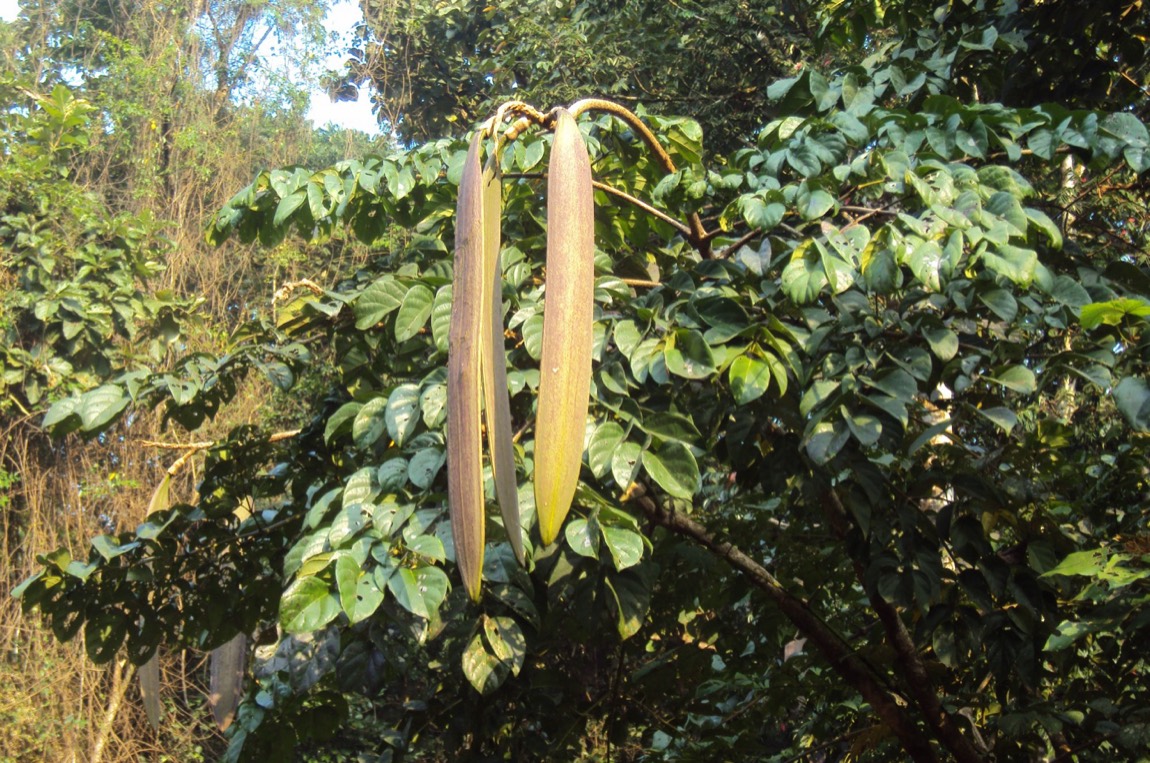

Shyonaka is the root bark of a tall tree, and one of the ten roots that Ayurveda groups together as Dashamoola. It is rarely used on its own, and is best known as part of the warming, settling blend of roots that the tradition reaches for to calm Vata and steady a weak digestion.
- Botanical name
- Oroxylum indicum
- Family
- Bignoniaceae
- Sanskrit
- श्योनाक
- Part used
- Root bark
- Taste (rasa)
- Bitter, astringent and sweet (tikta, kashaya, madhura)
- Quality (guna)
- Light and dry (laghu, ruksha)
- Energy (virya)
- Warming (ushna)
- After digestion (vipaka)
- Pungent (katu)
- Action (karma)
- Kindles digestion, settles Vata (deepana, pachana)
- Effect on dosha
- Pacifies Kapha and Vata (kapha-vata shamaka)
- Best known for
- One of the ten roots of the Dashamoola group
What is Shyonaka?
Shyonaka is the root bark of Oroxylum indicum, a tall tree of the trumpet-flower family that grows across India and much of tropical Asia. The tree is striking to look at. It carries very long, sword-shaped seed pods that hang down in the dark like blades, and when they split and drop their papery seeds the pieces gather at the foot of the tree in a way that gave it one of its old folk names, the broken bones tree. Its large flowers open at night, which is how it also came to be called the Indian trumpet tree.
For all the drama of the tree above ground, it is the part below ground that Ayurveda values. The root is dug, and its bark, the mula twak, is stripped, dried and used. The fruit and the stem bark are described in classical and folk use as well, and the young leaves and shoots are noted as edible, but the root bark is the principal medicinal part and the reason the tree is remembered. In Sanskrit the name Shyonaka is often paired with the everyday name Sonapatha, by which the tree is widely known in India today.
What Ayurveda uses it for
Shyonaka’s real standing in Ayurveda comes from the company it keeps. It is one of the ten roots that the tradition groups together as Dashamoola, and more precisely one of the five greater roots, the Brihat Panchamoola, which are all drawn from trees. Its four companions in that group are Bilva, Agnimantha, Gambhari and Patala. Almost everywhere Shyonaka appears, it appears as one voice in this chord of ten roots rather than as a soloist.
In that role the tradition values it for the same qualities the whole group is prized for. It is used within formulae that aim to support comfortable digestion, to settle the restless movement the texts call Vata, and to ease conditions of swelling and heaviness. Charaka places Shyonaka among the herbs said to reduce swelling and among those that calm cold-type disturbances, and lists it among the herbs used in the oily medicated enema known as anuvasana. As a member of the Dashamoola it also belongs to the rejuvenative and tonic side of Ayurveda, and turns up in the long root-based tonics and rejuvenative preparations of that tradition.
Its qualities, in plain words
Ayurveda describes every herb by a short list of qualities, and for Shyonaka they fit together into a clear picture. Its taste is mainly bitter and astringent, with a sweet note underneath. Bitter and astringent tastes tend to be drying and toning, the sort of tastes that firm things up rather than loosen them, which is why the tradition reads the root as steadying to a loose or unsteady bowel.
Its potency is warming, in most of the classical summaries, so it answers the cold, dry quality of Vata. Here the tradition is not perfectly of one mind. A minority of sources record the root as cooling rather than warming, so this is one property that is not asserted with complete certainty. After digestion its effect turns pungent, and its overall nature is light and dry. Put together, these qualities are why the texts describe the root as deepana and pachana, meaning it is understood to kindle the digestive fire and help the body deal with undigested matter, and why it is counted among the roots that settle both Kapha and Vata.
How it is taken
Shyonaka is very rarely taken by itself. Its classical home is inside compound preparations, and above all inside the Dashamoola root blend, where its root bark is combined in equal measure with the other nine roots. From that blend the tradition builds several familiar forms: a fresh decoction simmered from the roots, and gently fermented tonics of the arishta type, of which Dashamoolarishta is the best known.
Beyond the Dashamoola preparations, Shyonaka appears as one ingredient among many in some of Ayurveda’s large classical formulae, including the medicated oil Dhanwantaram taila and the well-known rejuvenative jam Chyawanprash. In every case it is a supporting root within a larger recipe rather than the headline ingredient. Because specific dosing of the classical preparations is properly a matter for a qualified practitioner, no dosage figures are given here.
Good to know
Like the rest of the Dashamoola, Shyonaka belongs to the warming, settling, grounding side of Ayurveda rather than the stimulating side, and it is used within formulae taken as a considered course rather than as a single dose for a single day. Because it is almost always one root among ten, the way it is used in practice is really the way its parent formula is used, and that choice sits with the practitioner who prescribes it.
This entry describes the classical Ayurvedic understanding of the herb. It is not medical advice, and anyone with a health condition should speak to a qualified practitioner.
Frequently asked
Why is it called the broken bones tree? Because of the fallen seed pods. The tree drops long, flat pods whose broken pieces pile up at its base, and the folk name grew from that sight. It is a description of the tree, not a claim about the herb.
Is Shyonaka ever used on its own? Rarely. Its classical place is inside compound preparations, most characteristically as one of the ten roots of Dashamoola, so it is usually met as part of a blend rather than as a single herb.
Which part of the tree is used? The root bark is the principal part. The fruit and stem bark are also described in classical and folk use, and the young leaves and shoots are noted as edible, but it is the root bark that carries the herb’s traditional reputation.
Bitter and astringent in taste and warming in strength, the root is counted among those that reduce swelling and calm cold-type disturbances.
After the Charaka Samhita, on the swelling-reducing and cold-calming groups of herbs
The root is numbered among the greater five roots of the Dashamoola group.
After the Sushruta Samhita, on the group of roots
Frequently asked questions
What is Shyonaka used for?
Shyonaka is the root bark of the tall Indian tree Oroxylum indicum, counted among the ten roots of the classical Dashamoola group. Ayurveda uses it traditionally to steady digestion and settle Vata, its action classed as deepana and pachana. Bitter, astringent and sweet in taste, it pacifies Kapha and Vata and is mostly used within formulas.
Is Shyonaka part of Dashamoola?
Yes. Shyonaka, Oroxylum indicum, is one of the five greater roots of the Dashamoola, or ten roots, group, the foundational combination behind many Vata-settling formulas. Its bitter, astringent and sweet rasa and its deepana, pachana action fit the warming, grounding character of Dashamoola. It is best known precisely for its place in that classical root group.
Which dosha does Shyonaka balance?
Shyonaka is described as kapha-vata shamaka, meaning it settles Kapha and Vata. Its bitter, astringent and sweet rasa and its digestion-kindling deepana action lighten the heavy, damp Kapha quality and steady the mobile Vata quality. This Kapha-Vata direction is why it sits comfortably in Dashamoola, the great Vata-settling root group of the classical texts.
What part of Shyonaka is used?
The part of Shyonaka used in Ayurveda is the root bark of the tree Oroxylum indicum, sometimes called Sonapatha. It is this bark, rather than the large seed pods for which the tree is often noticed, that carries the herb's digestion-kindling, Vata-settling qualities into Dashamoola and other classical formulas built on the ten roots.
How is Shyonaka taken?
Shyonaka is usually taken not on its own but within the Dashamoola group and the many formulas built on it, as a Kashayam decoction, a fermented Arishtam, or a medicated oil. The form and dose depend on the purpose and the person, so it is best used within a formula chosen by a qualified Ayurvedic practitioner.
References
- Charaka Samhita, Sutrasthana, chapter 4 (Shad Virechana Shatashritiya Adhyaya), on the swelling-reducing, cold-calming and medicated-enema-supporting groups of herbs.
- Sushruta Samhita, on the Brihat Panchamoola (greater five roots).
- Bhavaprakasha Nighantu, on the roots noted for digestive and bowel-settling qualities.