Materia Medica · Dravyaguna
Khadira
Senegalia catechu · Fabaceae
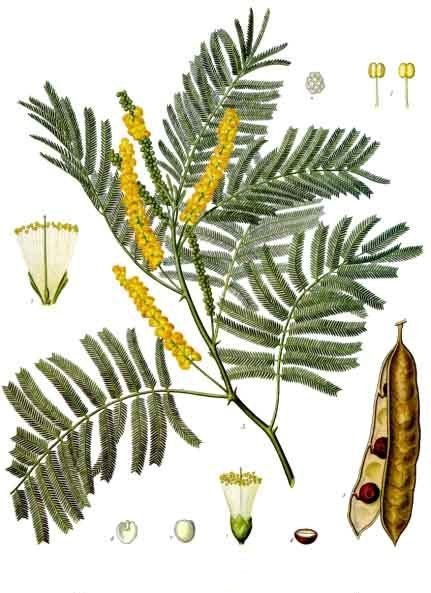

Khadira is a thorny tree whose dark, dense heartwood yields the well-known extract catechu. Ayurveda counts it as the leading herb for the skin, a bitter, astringent, cooling substance that dries damp conditions and clears the mouth and throat.
- Botanical name
- Senegalia catechu
- Family
- Fabaceae
- Sanskrit
- खदिर
- Part used
- Heartwood and its extract, bark
- Taste (rasa)
- Bitter and astringent (tikta, kashaya)
- Quality (guna)
- Light and dry (laghu, ruksha)
- Energy (virya)
- Cooling (shita)
- After digestion (vipaka)
- Pungent (katu)
- Action (karma)
- Purifies the skin, clears worms, scrapes away excess, settles Kapha and Pitta (kushthaghna, krimighna, lekhana)
- Effect on dosha
- Settles Kapha and Pitta (kaphapittahara)
- Best known for
- The classical herb for the skin and the mouth
What is Khadira?
Khadira is a medium-sized, thorny tree, Senegalia catechu, still widely written under its older name Acacia catechu, of the legume family. It grows across the drier forests of India, a spreading tree with feathery leaves, pale flower spikes and a trunk of hard, close-grained wood. The tree is unremarkable to look at, but it is what lies inside the trunk that Ayurveda has long prized: a dense, dark red heartwood.
That heartwood is boiled down to yield the substance the tradition calls Khadira sara, known in English as catechu or, in the everyday trade, kattha and cutch. It is a dark, brittle, intensely astringent extract, and it is one of the oldest and most familiar dyeing and tanning materials of the region. The same tree gives English several of its common names, Cutch tree and Catechu among them, while in the north of India it is widely called Khair or Kaath. In Ayurveda the heartwood, its extract and the bark are all put to use.
What Ayurveda uses it for
Khadira belongs first and foremost to the skin. The classical writers name it the leading substance among the kushthaghna herbs, those that purify the skin, and Charaka places it at the head of that group. Its bitter, astringent and drying nature was understood to clear the damp, sticky conditions the tradition links with Kapha and to cool the heat it links with Pitta. Alongside this it is described as krimighna, clearing worms, and lekhana, scraping away what has gathered in excess.
Within that role the dravyaguna texts describe Khadira as traditionally indicated in a familiar set of conditions, each named here in its classical Sanskrit term with a plain gloss:
- Kushtha: the classical group of skin disorders, Khadira’s foremost and most celebrated use.
- Krimi: the classical category of intestinal worms, where its clearing action is called upon.
- Meda: excess fatty tissue, addressed through its scraping, reducing quality.
- Mukharoga: disorders of the mouth, for which the astringent heartwood is a classical remedy.
- Kasa: cough, where the drying, astringent nature is applied.
- Prameha: the classical group of urinary and metabolic disorders.
- Vrana: wounds, cleaned and drawn together by its astringency.
- Kandu: itching, one of the common complaints of the skin.
These are the traditional textual indications recorded in the classical literature. They set out how Ayurveda has long understood the herb and are given for reference and study, not as statements of medical effect or as advice to treat any condition.
Its qualities, in plain words
Ayurveda describes every herb by a short list of qualities, and for Khadira they line up plainly behind its reputation as a purifier and drier.
Its taste is bitter and astringent, the two tastes Ayurveda associates most with cleansing, drawing together and drying. It is light and dry, so rather than feeding or grounding the body it lightens it and takes away damp, which is why the tradition turns to it for the sticky, moist conditions of aggravated Kapha. It is cooling, which suits the heat and irritation the texts link with Pitta. And after digestion it finishes pungent, a quality that keeps its overall action reducing rather than building. Put together, these describe a cool, dry, astringent substance, and this is exactly why the sources settle so firmly on its skin-purifying and Kapha-and-Pitta-pacifying role.
How it is taken
The most familiar form is the heartwood extract, Khadira sara or catechu, though the powdered heartwood and a decoction of it are also used. Because the substance is strongly astringent, it is often given in small quantity and prepared in ways that temper it.
From the heartwood the classical writers made a range of preparations. The best known is Khadirarishta, a self-fermented liquid preparation long associated with the skin, and Khadiradi Gutika, also called Khadiradi Vati, a classical lozenge held in the mouth for the mouth and throat. Khadira also appears by name in many of the Kushtha formulas, the compound remedies built around the skin, where it is frequently the central herb. As an astringent extract it was also applied outwardly, and the tradition often pairs the heartwood decoction with other bitter, skin-directed herbs.
Good to know
Khadira is one of the clearing, reducing herbs rather than a building one. Its nature is bitter, dry and astringent, so it belongs to the cleansing side of Ayurveda, not the nourishing side, and the classical writers reach for it where there is damp, heat or excess to be drawn away rather than where there is weakness to be fed. The same drying, astringent quality that makes it valued for the skin means it is used with a measured hand rather than in large amounts.
This entry describes the classical Ayurvedic understanding of the herb. It is not medical advice, and anyone with a health condition should speak to a qualified practitioner.
Frequently asked
Which part of the tree is used? Chiefly the heartwood, the dense dark wood at the centre of the trunk, and the dark extract boiled from it, which is catechu or kattha. The bark is also described in the classical literature, but it is the heartwood and its extract that most of the named preparations call for.
What is catechu, and is it the same as Khadira? Catechu is the extract of the Khadira heartwood, the substance the tradition calls Khadira sara and the trade calls kattha or cutch. It is the same tree: Khadira is the plant, and catechu is the concentrated heartwood extract taken from it.
Why does Ayurveda link Khadira so closely with the skin? Because its qualities, bitter, astringent, cooling and drying, are exactly those the tradition applies to the damp, hot skin conditions grouped under Kushtha. For this reason the classical texts name it the foremost of the skin-purifying herbs, and it stands at the centre of most classical skin formulas.
Khadira is bitter and astringent, cooling and drying; it is the foremost herb for the skin, and it clears worms and scrapes away what is excess.
After the Bhavaprakasha Nighantu, on Khadira
Among the substances that purify the skin, Khadira stands first.
After the Charaka Samhita, on the skin-purifying group of herbs
Frequently asked questions
What is Khadira used for in Ayurveda?
Khadira, from Senegalia catechu, is a hardwood whose dark heartwood extract Ayurveda holds as its foremost skin-purifying substance. Cooling, drying and astringent, it settles Kapha and Pitta. The texts class it as kushthaghna, krimighna and lekhana, so it is chiefly turned to for the skin and the mouth, and to scrape away excess.
What are the benefits of Khadira for the skin?
In tradition Khadira stands at the head of the Kushthaghna, skin-purifying herbs, valued for clearing troubled skin through its cooling, drying, astringent nature. It settles the Kapha and Pitta Ayurveda links with skin complaints and scrapes away excess, a lekhana action. It appears in classical skin formulas and washes as a clarifying, purifying substance.
How is Khadira taken?
Khadira is used as its heartwood extract, catechu, within decoctions, powders and classical formulations for the skin and the mouth, and in washes and gargles. The form and dose are matched to the complaint. Because it is drying and belongs to classical practice, it is best taken under a qualified Ayurvedic practitioner's guidance.
Is Khadira good for the mouth and gums?
Yes, Ayurveda classically uses Khadira for the mouth as well as the skin, valuing its astringent, drying, cooling nature in gargles and mouth care to tone the gums and settle Kapha and Pitta in the region. It appears in classical oral formulas. The preparation is chosen to fit the need and used under guidance.
Which dosha does Khadira balance?
Khadira settles Kapha and Pitta, being kaphapittahara, through its bitter, astringent, cooling and drying nature, which is why Ayurveda reaches for it in the hot, damp skin and mouth patterns tied to those Doshas. Being drying, it can aggravate Vata, so dry, Vata-dominant people use it within balanced formulas or under a practitioner's guidance.
References
- Charaka Samhita, Sutrasthana, chapter 25, where Khadira is named the foremost among the herbs that purify the skin (kushthaghna).
- Sushruta Samhita, Sutrasthana, among the Salasaradi gana, the group of hardwood herbs used for skin conditions and for reducing excess.
- Bhavaprakasha Nighantu, entry on Khadira with its synonyms, qualities and actions.
- Ashtanga Hridaya, in the treatment of Kushtha (the classical skin disorders), where Khadira preparations are described.
- Raja Nighantu, listing the many Sanskrit synonyms of the tree.