Foundations
Charaka Samhita
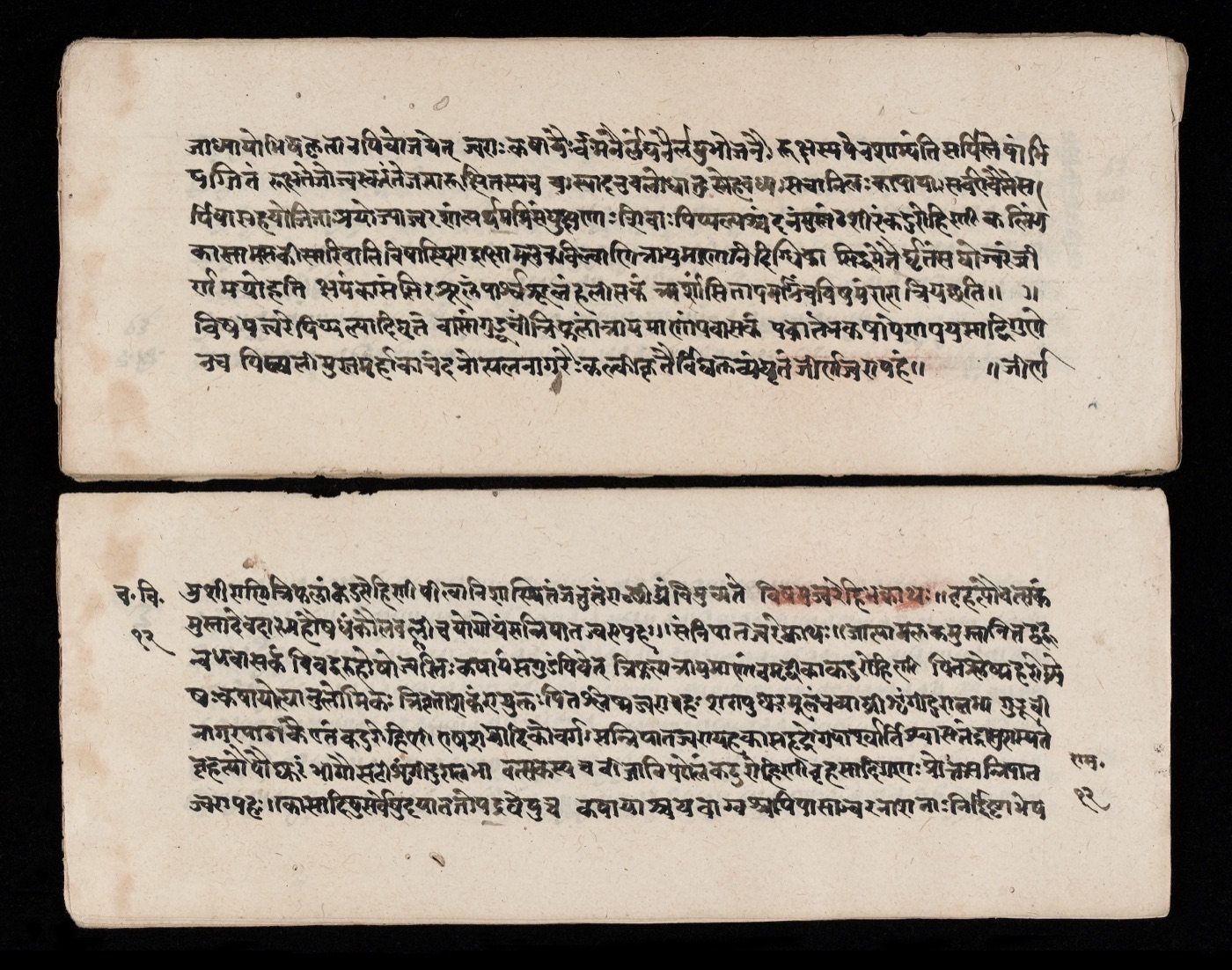

The Charaka Samhita is the oldest and most complete classical text on Ayurvedic medicine. For two thousand years it has been the book to which the tradition returns.
Overview
The Charaka Samhita is the central classical text of Ayurveda. If the whole tradition can be said to rest on one book, this is it. It is a long, ordered treatise on health and on illness: on what the body is, how it goes wrong, and how it may be set right. It has been read, taught and quoted without a break for around two thousand years.
The title means simply the compendium of Charaka. It stands as the first of the three texts the tradition calls the Brihat Trayi, the great triad, and of those three it is the one that deals most fully with kayachikitsa, the medicine of the body as a whole. To this day it is the first text an Ayurvedic student opens.
Where it came from
The Charaka Samhita did not arrive all at once. It came together in layers across many centuries, and the tradition is open about this.
The oldest teachings are credited to the sage Atreya, said to have taught at the ancient seat of learning at Taxila. His pupil Agnivesha set those teachings down in writing in a work known as the Agnivesha Tantra. Later the scholar Charaka revised and reordered that work, and it is his version that became authoritative and carries his name. Parts of the text were lost over time and were afterward restored by a scholar named Dridhabala, who filled the gaps from other sources. So the book as we have it is the work of several hands across several ages, which is part of why the tradition treats it as so settled.
How the text is arranged
The Charaka Samhita is divided into eight sections, called sthanas, each holding a part of the whole. Read in order, they move from first principles, through diagnosis, to treatment.
The first, the Sutrasthana, lays the foundations: what Ayurveda is, the theory of the three doshas, the elements, the tastes, and the rules of diet and daily routine. The Nidanasthana turns to diagnosis, the causes and signs by which illness is recognised. The Vimanasthana covers measurement and method, and includes the famous account of the physician, the medicine, the attendant and the patient as the four pillars of treatment. The Sharirasthana treats the body and its formation. The Indriyasthana is a striking section on reading the likely course of an illness. The Chikitsasthana, the largest, gives the treatments themselves, and it opens with the celebrated chapter on rasayana, the rejuvenation therapy. The last two, the Kalpasthana and the Siddhisthana, deal with the preparation of medicines and with the cleansing therapies, above all basti.
What it set down
Much of what we now think of as the framework of Ayurveda is given its fullest early form in this text. It carries the most complete classical account of the three doshas, Vata, Pitta and Kapha, the working principles of the body. It sets out the stages by which an illness gathers and unfolds, so that it might be met early. And it lays down the methods by which a physician examines a patient: by looking, by touch, and by careful questioning.
Beyond the medicine, the text is unusual for the weight it gives to conduct. It speaks at length about the ethics of the physician, about diet, about daily and seasonal living, and about keeping health in the well, not only treating the sick.
Its place today
The Charaka Samhita remains the principal textbook of Ayurvedic education. A student of the tradition still begins here, and a practitioner still returns here. It is studied not only for its medicine but for what it preserves of an old and ordered way of thinking about the body, the mind and the life that joins them.
This entry describes a classical text and its contents. It is offered for understanding, not as medical advice.
Frequently asked
Who wrote the Charaka Samhita? It is the work of several hands over time. The teachings are credited to the sage Atreya, first written down by his pupil Agnivesha, revised by Charaka, and later restored in part by Dridhabala.
What does it mainly deal with? Internal medicine, kayachikitsa, the care of the body as a whole. It covers theory, diagnosis, treatment, diet and the conduct of the physician.
Is it one of the three great texts? Yes. It is the first of the Brihat Trayi, the great triad of classical Ayurvedic texts, and the one most concerned with the medicine of the body.
Life is the union of body, senses, mind and the self, and Ayurveda is the knowledge of that life.
After the Charaka Samhita, Sutrasthana
Frequently asked questions
What is the Charaka Samhita?
The Charaka Samhita is the great classical text of Ayurvedic internal medicine, and the foundation on which much of the tradition rests. One of the Brihat Trayi, the great triad of classics, it lays out the theory and practice of Kayachikitsa, internal medicine: the doshas, digestion, diagnosis, treatment, ethics and the philosophy behind Ayurvedic thought.
Who wrote the Charaka Samhita?
The Charaka Samhita is traditionally traced to the teaching of Agnivesha, a pupil of the sage Punarvasu Atreya, whose work, the Agnivesha Tantra, Charaka later redacted and edited. It was further completed in part by Dridhabala. So rather than one author, it carries a lineage of teachers, with Charaka the great redactor who gave the text its name.
What are the main topics in the Charaka Samhita?
The text is arranged in eight sections, Sthanas, covering fundamentals and the doshas, diagnosis, the body, the senses, therapeutics, pharmacy and Panchakarma, and the training of the physician. It treats internal medicine, digestion and Agni, Rasayana and Vajikarana, and the ethics and reasoning of practice. It is the classical authority on Kayachikitsa.
How old is the Charaka Samhita?
The Charaka Samhita took its lasting form in the early centuries, redacted by Charaka from the older teaching of Agnivesha and later completed by Dridhabala, so scholars generally place it around two thousand years old, with roots reaching further back into the oral Vedic tradition. Precise dating is debated, but it is firmly among the oldest classics.
What is the difference between the Charaka and Sushruta Samhita?
Both are pillars of the Brihat Trayi, but they differ in focus. The Charaka Samhita is the great text of Kayachikitsa, internal medicine, dealing with the doshas, digestion, diagnosis and treatment by medicine and diet. The Sushruta Samhita is the foremost text of Shalya Tantra, surgery, describing operations, instruments and wound care. Together they cover medicine and surgery.
References
- Charaka Samhita, Sutrasthana, on the definition and scope of Ayurveda.
- Charaka Samhita, Chikitsasthana, opening chapter on rasayana (rejuvenation) therapy.
- Charaka Samhita, Vimanasthana, on the four pillars of treatment and the examination of the patient.